

Architectural manifestos
 16ᵗʰ arrondissement


🇬🇧 This journey has been automatically translated from its original french version. The translation might be inaccurate.
Dive into the early 20ᵗʰ century and discover how the architects of the time relied on the use of new materials and construction techniques to break away from classic Haussmann buildings. The urban landscape of the Auteuil district is still punctuated today by remarkable buildings, total works representative of the Art Nouveau, Art Deco then Modern movements.

Want to discover the journey ?
For total immersion, download our app and start the journey now!


Journey preview
Castel Béranger by Hector Guimard
 Elevation, album Le Castel Béranger: work by Hector Guimard © ETH-Bibliothek Zürich
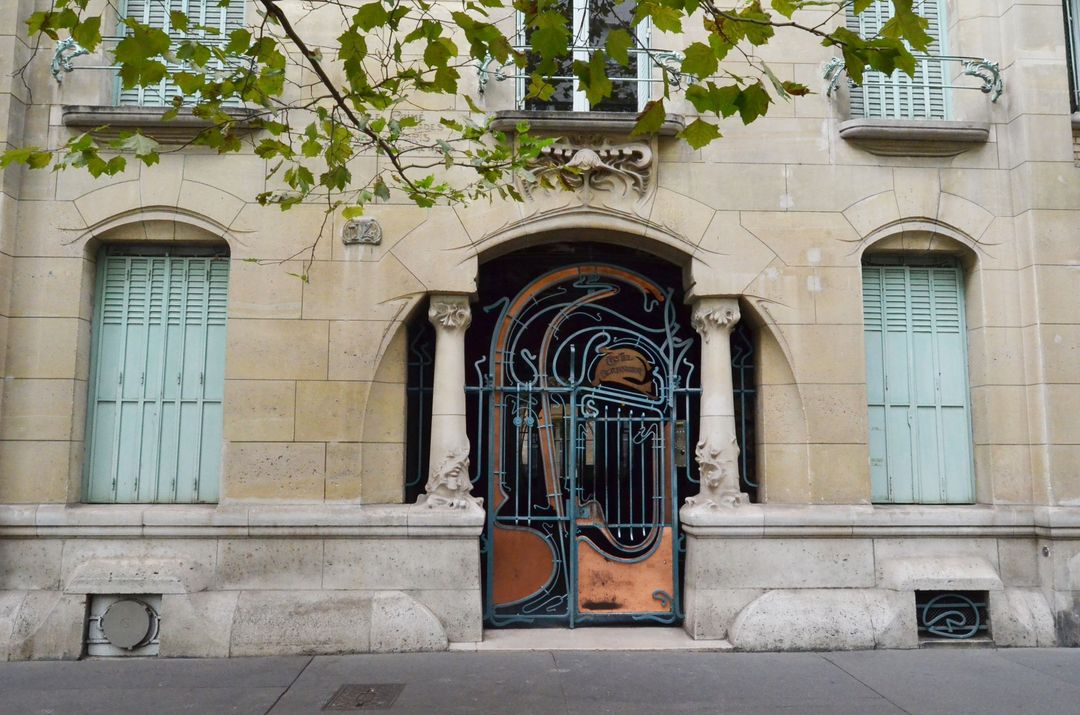
Here you are in front of the Castel Béranger designed by Hector Guimard and built between 1895 and 1898. This building, presenting a great diversity of materials, was rewarded with the prize for the most beautiful facade in Paris in 1898. This distinction greatly contributed to the notoriety of the architect who would later design the metropolitan pavilions (metro entrance) and numerous buildings in this district.
Under the influence of Victor Horta, a famous Belgian architect representing the Art Nouveau style, Hector Guimard designed his first so-called “rental” collective building in this style.
Art Nouveau
The Art Nouveau style is expressed in references to plants and the animal kingdom. We can, for example, cite here: the chain anchor representing a seahorse, the air intakes in the shape of crabs, the dolphin in the gate or the decorative motifs of the balcony railings.
Approach its wrought iron door and copper panels, and take a look at the main entrance to discover a world apart: from floor to ceiling!
 © CAUE de Paris
Through this main hall, Hector Guimard immerses residents and visitors in an original and colorful imaginary work. It offers a copper ceiling, porcelain stoneware wall cladding, a mosaic floor design and stained glass panels for the doors and transoms.
Hector Guimard greatly benefited from its architectural originality, particularly in communication.
 H. Guimard’s office © Smithsonian Institution/Cooper-Hewitt, Smithsonian Design Museum
In addition to setting up his agency at this address, the architect published a book bringing together architectural and decorative plans and drawings of the building.
Castel Béranger by Hector Guimard
Elevation, album Le Castel Béranger: work by Hector Guimard © ETH-Bibliothek Zürich
Here you are in front of the Castel Béranger designed by Hector Guimard and built between 1895 and 1898. This building, presenting a great diversity of materials, was rewarded with the prize for the most beautiful facade in Paris in 1898. This distinction greatly contributed to the notoriety of the architect who would later design the metropolitan pavilions (metro entrance) and numerous buildings in this district.
Under the influence of Victor Horta, a famous Belgian architect representing the Art Nouveau style, Hector Guimard designed his first so-called “rental” collective building in this style.
Art Nouveau
The Art Nouveau style is expressed in references to plants and the animal kingdom. We can, for example, cite here: the chain anchor representing a seahorse, the air intakes in the shape of crabs, the dolphin in the gate or the decorative motifs of the balcony railings.
Approach its wrought iron door and copper panels, and take a look at the main entrance to discover a world apart: from floor to ceiling!
© CAUE de Paris
Through this main hall, Hector Guimard immerses residents and visitors in an original and colorful imaginary work. It offers a copper ceiling, porcelain stoneware wall cladding, a mosaic floor design and stained glass panels for the doors and transoms.
Hector Guimard greatly benefited from its architectural originality, particularly in communication.
H. Guimard’s office © Smithsonian Institution/Cooper-Hewitt, Smithsonian Design Museum
In addition to setting up his agency at this address, the architect published a book bringing together architectural and decorative plans and drawings of the building.
Hameau Béranger
 Picturesque composition of the facades © CAUE de Paris
It is at the corner of the building that we best appreciate its general volume: its depth along the Hameau Béranger, its U shape around an interior courtyard, and its height including the chimney stack marks a signal in the street. From this point of view, the richness of the facade is expressed both by its materials and by its relief.
Ocher or red bricks, cast iron, millstones, sea green glazed bricks, glazed sandstone by Alexandre Bigot, base stones... Take the time to appreciate the polychromy of the materials used.
 Color chart of polychromy of materials © CAUE de Paris
The facade also demonstrates great freedom: asymmetry of its design, multiplicity of volumes (corner watchtower, bow windows, steps, balconies, cornices, dormer windows, etc.), variety of windows, etc.
Hector Guimard signs here a building whose aesthetic illustrates the know-how of artisans and craftsmen. This building is a total work of art whose interior decorations are even richer than the exterior. The architect leaves nothing to chance and imposes his style, drawing down to the smallest detail: wallpaper, door or radiator handles, stained glass windows, floor mosaics... He leaves behind a profusion of drawings (many of them they are today in the collections of the Musée d'Orsay).
 Art Deco drawing for the workshop of Hector Guimard © Hervé Lewandowski, RMN-Grand Palais (Musée d'Orsay)
“The plans, architectural and decorative drawings (sculptures, ironwork, mosaics, stained glass windows, fireplaces, wallpaper, hangings, coverings, stoneware, earthenware, interior furnishings, bronzes, etc.) which form the entire “Castel Béranger” were composed by Hector Guimard and are his property.” Extract from the cover page of the album Le Castel Béranger: work by Hector Guimard.
Block of buildings by Hector Guimard
 © Smithsonian Institution/Cooper-Hewitt, Smithsonian Design Museum
Barely 150 m from Castel Béranger, you will discover an islet almost entirely built up by Hector Guimard around 1910-1914. What strikes you first is the homogeneity of the color and material of the facades. Breaking with the originality of Castel Béranger, Hector Guimard places this real estate complex - later - in the continuity of the Parisian facades in blond stone.
Of the 11 buildings initially planned for rue Agar, rue Jean-de-la-Fontaine and rue Gros, six were built and formed the largest promotional complex of Hector Guimard's career, made possible by the land owned by his friend Léon Nozal.
Take the time to walk around the block to appreciate the more discreet ornamentation of the buildings:
- at n°17 rue Jean-de-la-Fontaine: the entrance, with rounded edges, is adorned with fine sculptures such as folds, stems, foliage or climbing plants which climb between the windows of the first floor floor. As soon as it is delivered, Hector Guimard installs different guardrails on the windows, thus creating a real life-size catalog of models that he has designed.
- at n°43 rue Gros: a column of bow windows topped with a dormer window marks the corner with rue Agar.
- at n°10 and n°8 of rue Agar: the stone door and window frames are inspired by a medieval decor with rounded lines, obliques, ribs, folds... Note the bottom of the descent of the iron gutters, decorated with floral-inspired motifs.
 © CAUE de Paris
On rue Agar, in the heart of the block, buildings no. 10 and no. 8 combine - for economic reasons - stone and brick. A constructive rationality which does not prevent the creation of bow window columns.
 © Smithsonian Institution/Cooper-Hewitt, Smithsonian Design Museum
Before returning to rue Jean-de-la-Fontaine, take a look at the relief street sign, which testifies to the Art Nouveau typographic work of the architect: as he signs his buildings, Here he creates the street sign and the numbering of the buildings.
 © CAUE de Paris
To finish and have a little fun, can you see the face formed in the fold of the facade?
Hôtel Mezzara by Hector Guimard
 © CAUE de Paris
The Hôtel Mezzara was built following an order from Paul Mezzara, textile industrialist, lace designer and also painter, to his friend Hector Guimard. This private mansion was built in 1911, it has an asymmetrical facade. To its left, a small turret with cut sides attaches to the building, set back from the neighboring building, in line with the street. The simplicity of the materiality of the building, in bricks and millstones, is balanced by the elegant design of the door and window frames.
This private mansion, listed in the supplementary inventory of historic monuments since 1994, is distinguished by its conservation of original elements, both exterior and interior.
 © CAUE de Paris
The fencing gate, like a very fine bramble, seems to transport us into a wonderful tale. This effect is reinforced today by the wild grasses which intrude between the paving stones, giving a magical aesthetic to this place. On the first floor, the cast iron railings are plant-inspired but their design is refined in a simple curved line.
This Art Nouveau ornamentation is found inside, from the entrance and exhibition hall, which still retains a majestic stained glass window in the center of a pleated ceiling, a staircase banister in wrought iron and decorative elements such as chandeliers.
 © CAUE de Paris
The dining room is a unique case in France of conservation in its original location, of a decorative set and furniture by Hector Guimard. Table, chairs and sideboards are in pear wood.
 © CAUE de Paris
This piece is decorated with a mounted canvas Le Goûter painted by Charlotte Chauchet-Guilleré, active member of the Société des artistes décorateurs (SAD).
Studio Building by Henri Sauvage
 © CAUE de Paris
Birth of Art Deco
The name Art Deco comes from french Arts décoratifs and the name of the school in 1877 : l'École des Arts décoratifs, or the Union centrale des arts décoratifs founded in 1882, with the aim: "to maintain the culture of the arts for the realization of beauty in utility". After the First World War, this name was transformed into Art décoratif moderne. The objective of modern decorative arts was to reconcile applied arts with industry.
The Decorative Art style was born in reaction to Art Nouveau. In the history of styles, Art Nouveau, described as exuberant, quickly went out of fashion. In the name of hygiene, economy and modernity, buildings are being refined and have a more social vocation.
The Studio Building
 © CAUE de Paris
Henri Sauvage designed and built this building for Jean Hallade, between 1926 and 1928. Of great aesthetic and volumetric modernity, it is still "undatable" today. The use of new industrialized materials (ceramic, reinforced concrete structure, etc.) and factory-pre-assembled elements make it an emblematic work of 20ᵗʰ century architecture.
The building can be seen from different distances:
- from a distance, we understand its grandeur: a large brown, white and gray monolith in the Parisian urban landscape,
- up close, we can read the detail of its graphics: a polychrome tiling which plays with the logic of the openings and the projecting elements of the facade.
This investment building, brings together fifty apartments for a bourgeois clientele, and offers a new typology of housing: duplex artists' studios. These duplexes can be read from the street, particularly through the bow windows at the corners of the building.
Take the time to observe the decorative details and shades of brown and gray of the glazed tiles from Gentil & Bourdet.
 © CAUE de Paris
- brown base separated from the upper floor, by an anthracite band and a thin white line,
- gray building punctuated with gold tiles,
- white edging which frames the windows, depth of the wall covered in brown,
- white, brown and gray vertical bands on the cut sides and bow windows...
An Art Deco expression whose polychromy contrasts with the facades of the interior courtyard, tiled in white (Graiblanc model, later used to cover the swimming pool building on rue des Amiraux).
Henri Sauvage
This architect has evolved his work over the course of his career, beginning in an Art Nouveau style (with, for example, the design of the Villa Majorelle in Nancy), he then moved towards a modern architectural vocabulary, clearly visible with this building. Friend of Hector Guimard, he participated alongside him in the founding in 1923 of the Group of Modern Architects. Both are designers who honor artisans in the design of their buildings.
Henri Sauvage is known for his fully tiled block buildings: both for the hygienic side of this material and also for its role in protecting the reinforced concrete structure.
Hôtel Guimard, by and for himself
 © CAUE de Paris
Ten years after the construction of Castel Béranger, Hector Guimard built a private mansion at 122 Avenue Mozart for his wife - the painter Adeline Oppenheim - and himself.
The Hôtel Guimard (1909-1912) combines an architectural studio on the ground floor, a place where the couple lived and received, and a painting studio for Adeline Oppenheim. Affirming a new, refined architectural aesthetic, this building becomes the emblem of his professional maturity.
The mass of the building takes on the appearance of a sculpture:
- asymmetry of the facades,
- cutting roof windows,
- variety of berries,
- balcony, loggia, bow windows: the relationship between interior and exterior is more assertive.
 Elevation villa side Flore © Smithsonian Institution/Cooper-Hewitt, Smithsonian Design Museum
Decors and furniture
Two years were needed for the interior design and furnishing of this building located on a triangular-shaped plot. For his own residence, the architect created a total work of great coherence.
 Dining room © CC0 Paris Musées/Petit Palais, Musée des Beaux-Arts de la Ville de Paris
Telephone exchange by Paul Guadet
 Auteuil telephone office © Orange, patrimoine historique
Paul Guadet, architect of the Ministry of Posts, Telegraph and Telephone (PTT), created this building in 1913, expressing his constructive method. The reinforced concrete punctuates the facade and its openings, and distinctly expresses the supporting elements highlighted with enamelled and colored pastilles, light brick filling elements.
This imposing building fits into the alignment of the street and into the tripartite composition of the Parisian urban landscape: treatment of a base, the body of the building and the crowning. However, the concrete allows for very high ceilings and high bays, useful for the function of this central office. The angle is highlighted by a rounded overhang.
Don't hesitate to approach the front door at No. 21 rue Jasmin to discover its colorful frame, made of sandstone tiles.
Guimard Building
 View of the Guimard building in the foreground and the Guadet telephone exchange in the back © CAUE de Paris
In the context of the interwar period, Hector Guimard's concerns evolved. This late building from his production (1926-1928) marks a turning point in his work:
- stylistic evolution towards a geometric aesthetic,
- greater sobriety and economy of the materials used,
- more discreet decorative elements.
Nevertheless, the architect signs a strong aesthetic here, with a facade design which amplifies its verticality. Hector Guimard places the column of bow windows in the center, this is punctuated by the beige stone mullions which form four large verticals. The impression of height is reinforced by the articulation between the stone of the base and the brick of the body of the building which draws a pyramidal graduation. Also note the decoration made with the bricks: vertical bands in hollow and relief, or the hanging ornaments. Finally, the attic floors and the roof stand out in a graduated manner against the sky.
 © Collection photographique des Archives de Paris
It was in this building that he resided with his wife from 1930 to 1938, before leaving France for the United States. He died in New York in 1942.
Maison La Roche by Le Corbusier and Pierre Jeanneret
 View of the houses La Roche and Jeanneret © CAUE de Paris
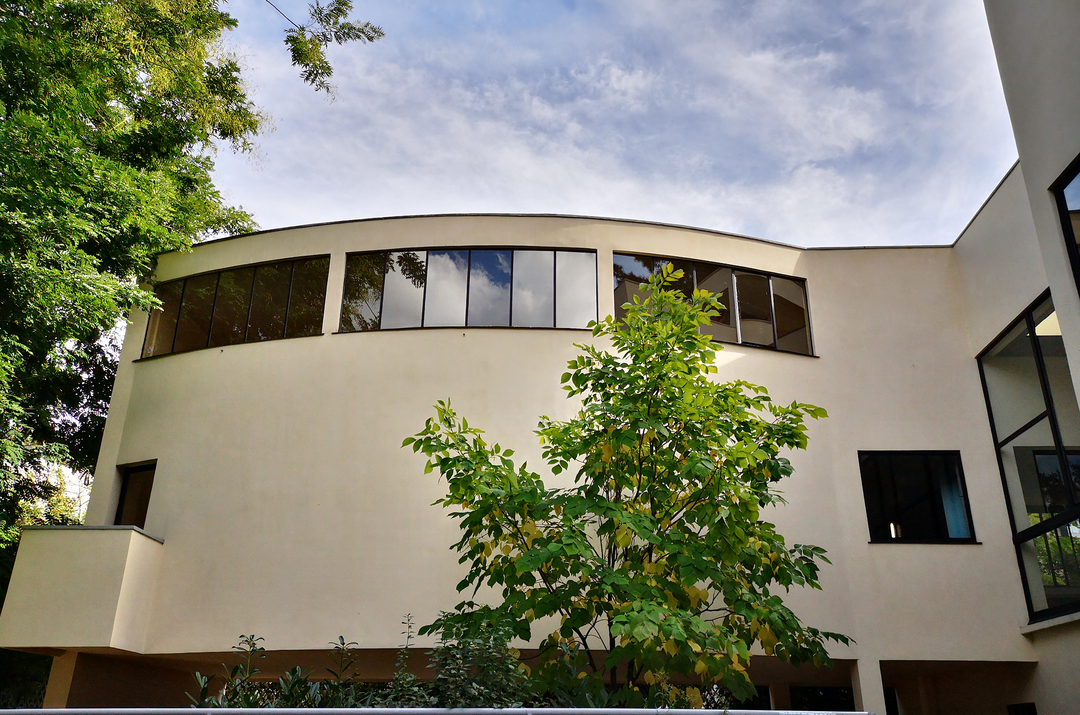
The La Roche and Jeanneret houses, built in 1924-1925 by Le Corbusier and Pierre Jeanneret (his brother) were, from their inauguration, a manifesto of modern architecture. Inseparable in their volume, they are designed as a whole combining painting, sculpture and architecture.
Raoul La Roche, collector of purist and cubist paintings, and friend of Le Corbusier, commissioned a villa from him, giving him carte blanche. The architect's intention is to create a setting worthy of his collections.
Modern architecture manifesto
Le Corbusier implemented for the Villa La Roche what he later theorized as the five points of modern architecture:
- the house on stilts: thus freeing up floor space,
- the free facade: the reinforced concrete framework allows you to freely compose the facade which is no longer load-bearing,
- the strip window: allowed by the free facade, this long bay exposed outside the facade, defied the laws of gravity at the time,
- the free plan: in the same way as for the facade, the post-beam structure allows the architect to freely compose and articulate the spaces,
- the roof terrace: a real solarium, in contact with the Parisian sky, this space revolutionizes the traditional relationship between house and garden.
 Underside of the gallery © CAUE de Paris
It is recommended to visit Villa La Roche in order to fully appreciate the proportions of the interior volumes and their colorimetry, and to experience what Le Corbusier called te architectural promenade.
 Interior of the La Roche house © CAUE de Paris
The Jeanneret house isn't open for visitors, it now houses the Le Corbusier Foundation: offices, library and archives.
Rue Mallet-Stevens
 Street facade © Ministère de la Culture (France), Médiathèque du patrimoine et de la photographie, diffusion RMN-GP
Here we come to the last stage of our journey. Robert Mallet-Stevens is the architect who designed, in this cul-de-sac, a coherent set of private mansions between 1926 and 1934. The height of recognition, he is one of the rare architects to have subdivided almost entirely a street, and what's more, a street in his name! However, the architecture that we have before our eyes today has been significantly transformed and even disfigured.
Robert Mallet-Stevens
Robert Mallet-Stevens is an architect and decorator, founding member of the Union of Modern Artists. He began his career as a decorator, particularly for cinema. In particular, he designed the sets for the film L'In humaine by Marcel l'Herbier in 1924 and then created a resolutely modern and surrealist architectural setting.
His achievements are linked to the aesthetics of the De Stijl movement. In 1923, an exhibition of this movement, presented at the Galerie de l'Effort Moderne, would strongly influence Robert Mallet-Stevens.
The International Exhibition of Modern Decorative and Industrial Arts of 1925 will put him in the spotlight. He then presents several constructions, some of which, such as a garden with cubist concrete trees (designed with the Martel brothers), are controversial. The exhibition is a success, it contributes to the diffusion of reinforced concrete. Like Le Corbusier, he opted for this new constructive process which allowed him to create long or angled windows, flat roofs and smooth geometric volumes.
He highlights his collaborators: sculptors, master glassmakers, interior designers, decorators... This exhibition will bring him notoriety and a wealthy clientele.
Rue Mallet-Stevens
Along this dead end there are five private mansions and a caretaker's house. Although different in their programs, they are designed in the same spirit in order to create unity. The architect's intention is to articulate the volumes of the architecture (stands, terraces, belvedere, etc.) with the width of the street, in order to provide air, light and vegetation. . Despite the densification of this dead end and the modifications made to the initial buildings, it is possible to detect their presence thanks to the striped concrete strip which marks their base.
 Signature of Robert Mallet-Stevens on the buildings © CAUE de Paris
By returning to the impasse, you will follow in the footsteps of:
- the Mallet-Stevens mansion and agency at n°12,
- the Martel brothers’ hotel-workshop at number 10,
- the private mansion of the pianist Ms. Reifenberg at n°4-6,
- the private mansion of Daniel Dreyfus, sponsor of the subdivision, at number 7,
- the private mansion of Mr. Allatini, filmmaker, and his wife, at n°3-5
- the caretaker's house at n°1.
 Details to observe © CAUE de Paris
This street served as the setting for the film La Sirène des Tropiques (1927) by Mario Nalpas and Henri Etievant, with Joséphine Baker.
 Rue Mallet-Stevens © CAUE de Paris
Hotel-workshop for the Martel brothers by Robert Mallet-Stevens
 Exterior view with Joël Martel © Ministère de la Culture (France), Médiathèque du patrimoine et de la photographie, diffusion RMN-GP
The private mansion of the brothers Joël and Jan Martel, sculptors, is the only one that has retained its initial appearance.
Three remarkable elements are to be discovered in more detail:
- the entrance gate door, made of folded strips of silver lacquered metal, by Jean Prouvé,
- the cylindrical tower of the main staircase whose verticality is accentuated by a stained glass window by Louis Barillet, topped with a disc covered with red glass paste,
- the large sliding door of the workshop and its frosted glass plaque, indicating “Joël and Jan Martel sculptors”.
This private hotel is today an art and design gallery, Galerie 54, which opens its doors in summer, in order to present to the public the workshop of the Martel brothers.
 © CAUE de Paris
The layout and colorimetry of the tiling on the floor, defined by the Martel brothers, delimit spaces in this workshop. The gray metal tube railings, liner-style, always accompany the descent of the stairs. Finally, the radiators are hung on the wall, like paintings of modern comfort.
Hôtel particulier by Robert Mallet-Stevens
 Private mansion © CAUE de Paris
The mansion for the pianist Mrs. Reifenberg was the first built on the street. In front of this imposing building, it is possible to feel the influence of Robert Mallet-Stevens' experience in the cinema set.
The entrance is marked by a “glass box” at the corner of the building, whose presence is reinforced by a canopy of the same materiality. Behind it is an entrance gate made by Jean Prouvé.
Robert Mallet-Stevens works in favor of modern architecture: coated cubic volumes, flat roofs, no cornice on the facade, sliding windows with blinds...
The mansion spreads out on either side of its staircase tower, lit by a long stained glass window by Louis Barillet and Le Chevallier.
It is interesting to note that almost 100 years later, this subdivision is still very modern architecturally. If Le Corbusier had divided up - as he had wished - the Square du Docteur-Blanche, the proximity of these two developments would have been interesting to observe. Despite its interest, the work of Robert Mallet-Stevens gradually fell into obscurity after his death in 1945, only to be recently rediscovered. All of the buildings on this street are today partially registered as historic monuments.
Side activities

Access the journey
 Bus
Bus
Ranelagh (line 70)
 Metro
Metro
Ranelagh (line 9)
 Vélib'
Jean de la Fontaine - Boulainvilliers (station n°16025)