

Opera District: An ostentatious era
 9ᵗʰ arrondissement

Dive into the bustling atmosphere of the Opéra-Chaussée d’Antin district and discover its splendour, from the Belle Époque to the Roaring Twenties, as you take a walk back through time!
A young college student of the time will be your guide, taking you through the streets and telling you all about the great innovations of the period, the development of the entertainment industry, the eclectic architecture, and much more!

This route has been created in partnership with the Opéra-Chaussée d'Antin district council of the 9ᵗʰ arrondissement mayor's office.

Want to discover the journey ?
For total immersion, download our app and start the journey now!


Journey preview
Lycée Condorcet
 Contemporary façade of the former Couvent des Capucins © CAUE de Paris
Famous for having taught some illustrious students, the Lycée Condorcet was not always a place of education!
Writer Marcel Proust, parfumier Jean-Paul Guerlain, aviator Louis Charles Breguet, painter Henri de Toulouse-Lautrec… the Lycée Condorcet saw numerous figures from the Belle Époque flourish, in a period when France had aspirations of revival and progress based on the promotion of science, the arts, and literature.
In 1780, Louis XVI had a convent built, reserved for a community of Capuchin friars but with a chapel open to the public: the Couvent des Capucins.
 Drawing, quill-drawn elevation, Indian ink and watercolour, Couvent des Capucins © gallica.bnf.fr/Bibliothèque nationale de France
A convent in the Neo-classical style
The convent buildings, with their Neo-classical style, were constructed by Alexandre Brongniart, the architect who created the headquarters of the Bourse de Paris. This architectural movement, which emerged at the end of the 17th century, is characterised by the use of elements from ancient architecture.
In the centre, we can see the convent entrance with its distinguishing portico supported by columns with Doric capitals. At opposite ends of the façade are two pavilions beneath a triangular pediment. The one on the left houses the chapel which became the parish church of Saint-Louis d’Antin in 1795. The one on the right is the monks' parlour. A prominent cornice brings the whole façade together.
 Lithograph, Jules Arnoult © Paris Musées / Musée Carnavalet – Histoire de Paris
From convent to college
After the French Revolution, the buildings were turned into a print shop, then a nursing home. At the same time, the French government took over the former premises of the convent to found a college in 1802. It would become one of the four oldest colleges in Paris, and opened its doors under the name Lycée de la Chaussée d’Antin. It changed names several times along with the various regimes, finally adopting Lycée Condorcet in 1883.
 The Lycée exit © Ville de Paris / BHVP
Between 1805 and 1808, Alexandre Brongniart got back to work, erecting a fourth section of the building which closed off the cloister – now the college courtyard – raising the height of the building, and decorating it with a small bell tower which has been an integral part of the structure's silhouette ever since. In 1865, architect Jean-Louis Duc erected the buildings of the present-day college, which look out over Rue du Havre. The college entrance is now on this street, no longer on Rue de Caumartin.
Lycée Condorcet
Contemporary façade of the former Couvent des Capucins © CAUE de Paris
Famous for having taught some illustrious students, the Lycée Condorcet was not always a place of education!
Writer Marcel Proust, parfumier Jean-Paul Guerlain, aviator Louis Charles Breguet, painter Henri de Toulouse-Lautrec… the Lycée Condorcet saw numerous figures from the Belle Époque flourish, in a period when France had aspirations of revival and progress based on the promotion of science, the arts, and literature.
In 1780, Louis XVI had a convent built, reserved for a community of Capuchin friars but with a chapel open to the public: the Couvent des Capucins.
Drawing, quill-drawn elevation, Indian ink and watercolour, Couvent des Capucins © gallica.bnf.fr/Bibliothèque nationale de France
A convent in the Neo-classical style
The convent buildings, with their Neo-classical style, were constructed by Alexandre Brongniart, the architect who created the headquarters of the Bourse de Paris. This architectural movement, which emerged at the end of the 17th century, is characterised by the use of elements from ancient architecture.
In the centre, we can see the convent entrance with its distinguishing portico supported by columns with Doric capitals. At opposite ends of the façade are two pavilions beneath a triangular pediment. The one on the left houses the chapel which became the parish church of Saint-Louis d’Antin in 1795. The one on the right is the monks' parlour. A prominent cornice brings the whole façade together.
Lithograph, Jules Arnoult © Paris Musées / Musée Carnavalet – Histoire de Paris
From convent to college
After the French Revolution, the buildings were turned into a print shop, then a nursing home. At the same time, the French government took over the former premises of the convent to found a college in 1802. It would become one of the four oldest colleges in Paris, and opened its doors under the name Lycée de la Chaussée d’Antin. It changed names several times along with the various regimes, finally adopting Lycée Condorcet in 1883.
The Lycée exit © Ville de Paris / BHVP
Between 1805 and 1808, Alexandre Brongniart got back to work, erecting a fourth section of the building which closed off the cloister – now the college courtyard – raising the height of the building, and decorating it with a small bell tower which has been an integral part of the structure's silhouette ever since. In 1865, architect Jean-Louis Duc erected the buildings of the present-day college, which look out over Rue du Havre. The college entrance is now on this street, no longer on Rue de Caumartin.
Printemps
 Contemporary façade of the Printemps Haussmann building © CAUE de Paris
Printemps was founded in 1865 by Jules and Augustine Jaluzot, a visionary couple who began setting up the chain of shops in a district that at that time was not an accessible shopping area. Opéra Garnier was no more than a vast building site next to the train station, with a reputation for being noisy and even disreputable. The store was officially opened on 3 November 1865. It was designed by architects Sédille and son.
 View of the façade of the Printemps Haussmann building, photograph, 1883 © Collection Printemps Héritage
Commercial innovation
The Jaluzots created a new concept: the end of season sales. Goods were sold at a fixed price, and no haggling was allowed. They were so successful that they took on four more buildings in 1874. Iron bridges were constructed to connect them and – the highlight of the show – Printemps was the first department store to be fitted with lifts.
 Sales catalogue, 1866 © Collection Printemps Héritage
 Illustration "Les ascenseurs de Vienne" (The lifts from Vienna), published in L'Univers Illustré n°1026, 1874 © Collection Printemps Héritage
 View of the panoramic lifts in one of the halls in the new stores, photograph, 1920s © Collection Printemps Héritage
Fire and renewal
In 1881, a fire ripped through the shop, which at that time was lit with gas and candles. Rebuilt in 1882 by Paul Sédille, it was seen as a prototype for large modern stores. Printemps was the inspiration for the cathedral of commerce described by Émile Zola in The Ladies' Paradise (Au bonheur des dames), which was published the following year. In 1883, Printemps installed an electric system which was safer and would show off the products in their best light. The City de Paris only began to very gradually switch to electric lights from 1889.
 View of the Charras hall, photograph, 1910s © Collection Printemps Héritage
 The Printemps fire © gallica.bnf.fr/Bibliothèque nationale de France
The dome, an Art deco treasure
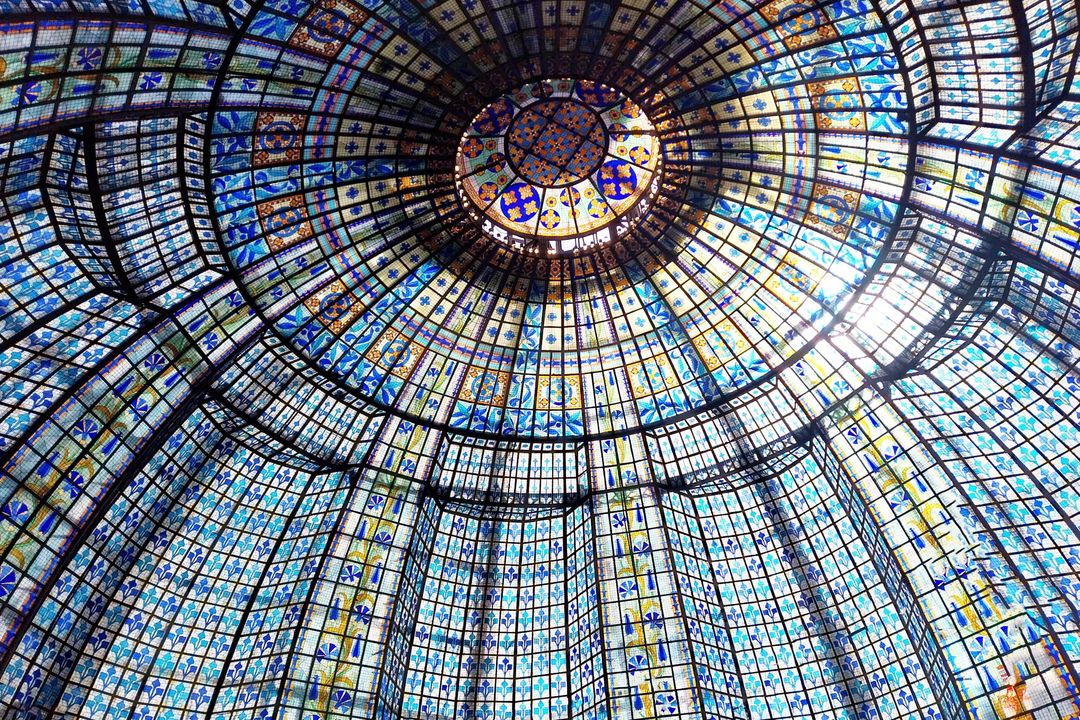
The dome was created in 1923 by master glass-maker Eugène Brière. In an Art deco style characterised by plant-based forms, it depicts a sky full of flowers: the leitmotif of Printemps (Spring). The glass panels were taken down in 1939, just before the Second World War broke out, for fear of bombing. They were put into storage and restored in 1973, then again in 2021.
 Printemps dome © CAUE de Paris
The Turkish baths
 Contemporary façade, no. 18 Rue des Mathurins © CAUE de Paris
A remarkable façade in the Moorish style stands at no. 18 Rue des Mathurins. In 1876, architects William Klein and Albert Duclos built a Turkish baths in a Neo-Moorish style on this site, at a time when Orientalism was all the rage, amplified by a fascination for the exotic.
 Façade, no. 18 Rue des Mathurins, 1919 © Charles Lansiaux / DHAAP
A Neo-Moorish façade
Neo-Moorish architecture first emerged in the 19th century. This style combines elements of Moorish and European architecture. Some examples are horseshoe-shaped arches, windows with stone frames, sculpted floral motifs, and balcony ironwork inspired by mashrabiya.
 Details of the façade, floral motifs and ironwork © CAUE de Paris
A place for personal hygiene and social niceties
The Turkish baths on Rue des Mathurins initially reveal a taste for the Orientalism that can be seen in the paintings of Ingres and Delacroix, but also for the hygienist theories of the late 19th century. Various services and amenities were available at Turkish baths: massages, hydrotherapy, swimming pools…
A place for personal hygiene, it was also a place of relaxation for aristocrats, politicians, bankers, and artists. It would have been frequented by Léon Gambetta, Baron Haussmann, the Prince of Wales, and even Baron Rothschild…
 Inside the Turkish baths © Charles Lansiaux / DHAAP
 Advertising poster, 1876 © gallica.bnf.fr/Bibliothèque nationale de France
A celebrated establishment of the 'Belle Époque', "Le hammam, bains turco-romains", officially opened in 1876, closing its doors for the last time in 1954. Following a change of use, all of the interior decor was destroyed. The façade is the only remaining trace of this site which was so famous in its day.
Eden-Théâtre
 View of Square Athénée Louis-Jouvet © CAUE de Paris
Here you are in front of Square de l’Opéra-Louis-Jouvet. This private street opened in 1896, on the site of the magnificent Eden-Théâtre at no. 7 Rue Boudreau. It owes its name to the Opera neighbourhood; and the name of the actor Louis-Jouvet, director of the theatre next door of the same name, was added to it in 1955.
 To the left, View of the Eden-Théâtre, 1880 © Paris Musées / Musée Carnavalet – Histoire de Paris
To the right, view towards Square Athénée Louis-Jouvet © CAUE de Paris
To the left, View of the Eden-Théâtre, 1880 © Paris Musées / Musée Carnavalet – Histoire de Paris
To the right, view towards Square Athénée Louis-Jouvet © CAUE de Paris
A grand theatre
William Klein and Albert Duclos, architects of the Turkish baths on Rue des Mathurins, built a performance hall named Eden in 1876, in the same Orientalist style, with the aesthetic of a Hindu temple; it was followed by the Grand-Théâtre, and finally the Eden-Théâtre.
 Inside the Eden Théâtre, 1880 © Paris Musées / Musée Carnavalet – Histoire de Paris
At the time it was the largest Parisian theatre after the Opéra Garnier, with 1,600 seats. This theatre took up a large proportion of the plot of land, including the current site of Square de l’Opéra-Louis-Jouvet. The Eden-Théâtre featured a winter garden, restaurants and an underground cycling track.
 Inside the Eden Théâtre, 1880 © Paris Musées / Musée Carnavalet – Histoire de Paris
 Inside the Eden Théâtre, 1880 © Paris Musées / Musée Carnavalet – Histoire de Paris
The theatre was demolished in 1895 to make way for a real estate project. A new way into Square de l’Opéra-Louis-Jouvet was opened at no. 7 Rue Boudreau and buildings were erected on either side. The current Théâtre de l’Athénée Louis-Jouvet was built in one of the halls of the Eden-Théâtre. The cycling track can still be seen in the basement of the Musée Fragonard, located at no. 5 Rue Boudreau.
Athénée Théâtre Louis-Jouvet
 Contemporary façade © Dimitri Bourriau
On the eve of World War I, the theatre still seemed to dominate cultural life in France. Cultural offerings were staged at a sustained pace, led by stars of the stage and great writers.
 Lithograph from 1876 © gallica.bnf.fr/Bibliothèque nationale de France
Inaugurated in 1893 in a former hall of the Eden-Théâtre, this theatre was known by a variety of names, including Comédie Parisienne, Athénée-Comique, and then Athénée. Its current name, Athénée Théâtre Louis-Jouvet, is a tribute to its director from 1934 to 1951, who left his mark on the place.
 Detail of the façade © CAUE de Paris
Classified as a historic monument, this façade has not always been the theatre’s main façade! The year 1896 is engraved on the main façade, that was moved from Rue Boudreau to Square de l’Opéra-Louis Jouvet to protect it from urban disruption.
The façade was built in an Art Nouveau style, characterised by features such as rounded shapes. Examples can be found in the wooden joinery and the guard rails. On the ground floor, a continuous bossage runs along the façade on either side of two basket-handle arches. The ground floor is topped with an awning, supported by 5 brackets adorned with organic motifs. On the upper floors are pilasters topped with cornices.
 Interior view of the performance hall © Dimitri Bourriau
The theatre features a blend of several architectural styles. The inside of the building is designed in a highly decorative neo-Rococo style.
We see organisational features typical of Italian theatres, with horseshoe-shaped galleries and audience members placed according to social rank; the purpose of the layout was to see and be seen. The social order is clear to see in the various coded areas: boxes, balconies, the parterre.
Théâtre Édouard VII
 Contemporary façade of the Théâtre Édouard VII © CAUE de Paris
The construction of the Théâtre Édouard VII was the focus of a real estate development project carried out from 1911 to 1913, led by architect Henri Nénot. Place Édouard VII was opened onto a site occupied by the Compagnie Générale des Voitures, which it used to keep 500 horses and 200 carriages. The purpose of the project was to develop Rue Édouard VII and Place Édouard VII to build offices, a hotel, businesses, and a theatre.
 Carriage, taximeter, Compagnie générale des voitures à Paris © Paris Musées / Musée Carnavalet – Histoire de Paris
An English theatre
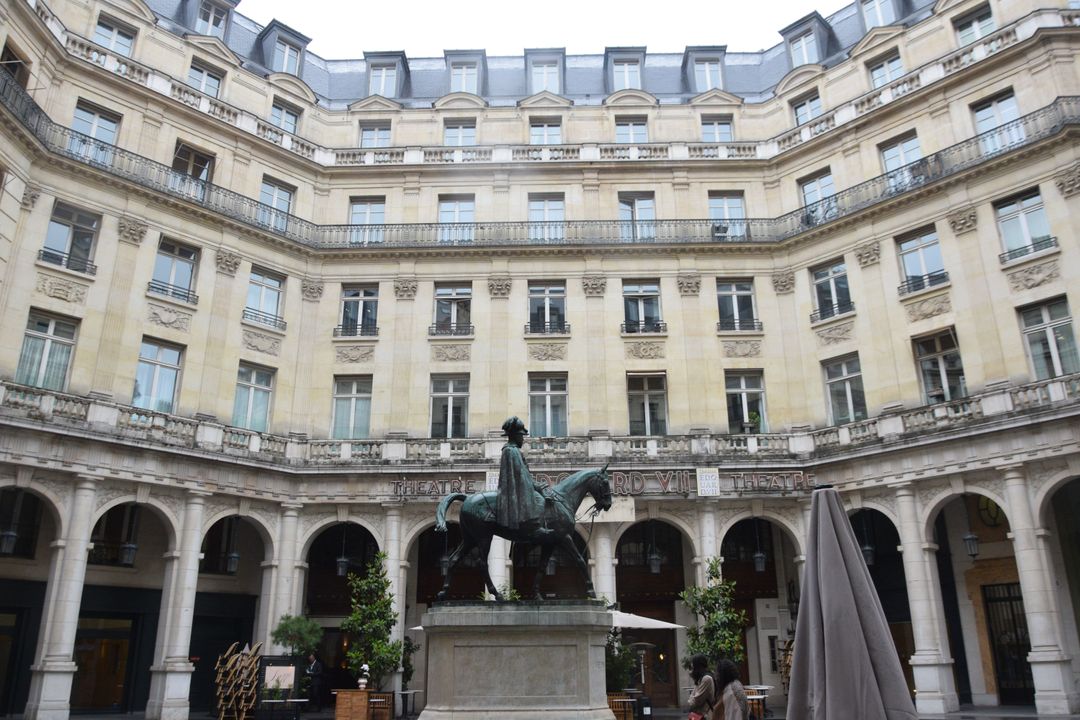
The Théâtre Édouard VII was built by British architect W.G.R. Sprague in 1913 in homage to King Edward VII, a Francophile. An equestrian sculpture representing the King sits in the centre of the square. This bronze statue was created by Paul Landowski, a sculptor who became famous for creating the statue of Christ the Redeemer on the Corcovado Mountain in Rio de Janeiro.
 Paul Landowski’s statue of King Edward VII © Charles Lansiaux / DHAAP
The age of cinema
Before becoming a theatre, the space opened as a cinema, with projections of films in kinemacolor. Devised by Charles Urban and George Albert Smith, this revolutionary process enabled the projection of motion pictures in colour onto the screen.
 Programme for the Kinémacolor, 1913 © Charles Urban, Science Museum Group
The Kinémacolor was replaced by a theatre in 1916. The site was converted into a 700-seat hall.
The Olympia
 Contemporary façade © CAUE de Paris
Known for staging some of the greatest artists, from the time it opened (Mistinguett, Yvonne Printemps, etc) until the present day, the Olympia has not always been a concert hall!
 Print from 1885 © gallica.bnf.fr/Bibliothèque nationale de France
Founded in 1888 by Joseph Oller, creator of the Moulin Rouge, the Olympia concert hall has hosted a variety of programmes, all of them connected to the world of entertainment. It first featured roller coasters, fairground attractions, and then a cinema, before becoming a music hall in 1893. This final change of activity came at a time when society was seeing the emergence of non-theatrical shows, including music halls, which were becoming very popular. The Olympia hosted many different artists
 Photograph of the façade in 1914 © gallica.bnf.fr/Bibliothèque nationale de France
In the early 20th century, the façade of the Olympia displayed the names of the artists on the programme somewhat timidly, well before it became the mythical façade with red neon lights that we know today.
In the 1990s the Olympia was under threat from a real estate development project. In the end the music hall was saved, and one of the only changes made was the building of an identical performance hall, a few metres away at the end of a long corridor. The building was saved in part due to sections of it, including the façade, being classified as a historic monument.

 Contemporary photographs © CAUE de Paris
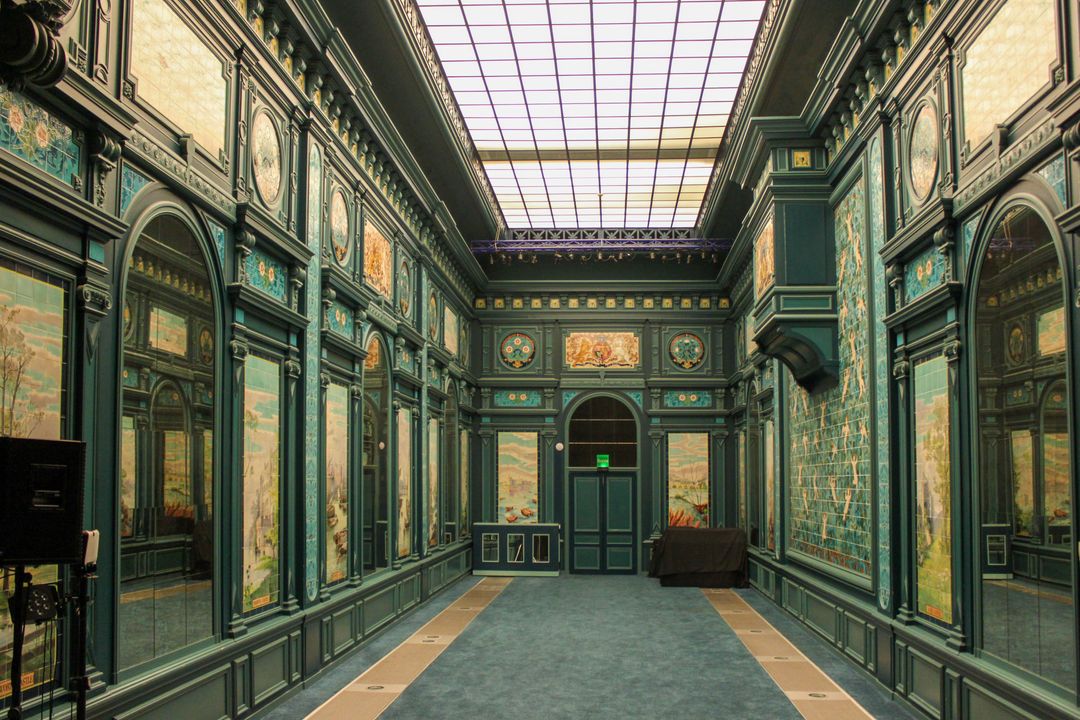
The Olympia harbours an unsuspected treasure, namely a former billiard room, also classified as a historic monument. With 6-metre-high ceilings, this hall is adorned with sculpted woodwork and Sarreguemines ceramics. They date back to the 19th century and were apparently made in honour of Edward VII, Prince of Wales (now King of England). Royal coats of arms can be seen hanging above the door, and landscapes depicting the United Kingdom and Ireland are displayed on the various bays.
Grand-Hôtel
 Contemporary façade © CAUE de Paris
Built in 1860 on the Pereire brothers’ initiative, the Grand-Hôtel is located on the same square as the Opéra Garnier. Its façades, which stretch for several hundred metres, reproduce the conventional architecture of the buildings surrounding the Opera House. The building occupies a triangular island surrounded by Haussmann’s imposing works. It was inaugurated in 1862, in the presence of Empress Eugénie.
 Photograph from 1919 © Charles Lansiaux / DHAAP
It was a large-capacity travellers’ hotel, with more than 800 extremely comfortable rooms, heralding a revolution in the way people travelled. It hosted high-end guests: Parisians, businessmen and wealthy tourists alike.
 Photograph of the glass roof in 1919 © Charles Lansiaux / DHAAP
 Photograph of the glass roof in 2024 © CAUE de Paris
Like the Crystal Palace in London, a building emblematic of 19th-century architecture, the Grand-Hôtel combines iron and glass, in particular in the glass roof covering the inner courtyard. The original has been replaced by another, rather more streamlined pyramidal glass roof that allows as much sunlight into the room as possible.
Well aware of the advances being made in their era, the Pereire brothers equipped the hotel with a host of innovations: "monte-voyageurs", synonymous with novelty and the predecessors of our modern-day lifts, central heating for circulation areas, clocks that ran on electricity, and a pneumatic communication system with the Paris Stock Exchange.
Former head office of the Calmann-Levy publishing house
 Contemporary façade © CAUE de Paris
This building is the** the former head office of the Calmann-Levy publishing house**, the first publishing house to set up shop on the Seine’s right bank. In 1868, Michel Levy, one of its two founders, purchased**** a plot of land over 1,300 m² with a view to building an investment property on it (a building with a single owner, acquired in order to collect rent from its tenants) and a new head office coupled with a bookshop.
The architect Henri Fèvre was tasked with building the publishing house. The main façade is classical in style and composed of dressed stone. It consists of 3 bays bordered by pilasters with Corinthian capitals. Three round-arched openings **on the ground floor ** are topped with keystones decorated with volutes and plant motifs. The entrance is marked by two columns with Corinthian capitals composed of acanthus and laurel leaves. On the upper storey, there are 3 bay windows with balusters, topped with pediments, triangular for the central bay and rectangular for the two external bays. Each level is marked by a cornice and the building is crowned by a penthouse.
 Contemporary façade © CAUE de Paris
Even though it might seem paradoxical, the head office’s main façade gives onto Impasse Sandrié. Actually, ** visibility was not particularly important for the business** as it was mainly intended for professionals, and its location in a cul-de-sac made deliveries easier.
Nothing on the outside betrays the iron and glass architecture within. Yet the building is topped by a glass roof 24 metres high, lighting the premises on several levels while enabling a watchful eye to be kept on the shop.
These days, the building houses a multipurpose venue called Le Shack, which includes a restaurant, bar, and co-working area.
Opéra Garnier
 Contemporary façade of the Opéra Garnier photo to be requested from the Opera / without work site
An emblematic edifice, the Opéra Garnier was inaugurated in a threatening context. On 14 January 1858, just as he arrived in front of the Opéra Le Peletier, Napoleon III was targeted by Italian revolutionaries.
The failed assassination attempt hastened the announcement of **a competition for the construction of a new opera house, ** one that ensured the Head of State’s security. Napoleon III wanted to build a sumptuous venue to his own glory and leave his mark on Parisian architecture. In 1861, the young Charles Garnier won the competition from among a total of 171 submissions.
 Place de l'Opéra Garnier, 1921 © gallica.bnf.fr/Bibliothèque nationale de France
Multiple innovations
As well as being able to accommodate over 2,000 people, it was the world’s first electrified opera house. There was even a small power plant in the basement. This innovation was to revolutionise live performance. Before the arrival of electricity, stages were lit by candles. Consequently, a play’s division into acts was calculated on the time it took for the candles to burn out.
It was also at the Opéra Garnier that the phonograph, a machine that recorded sounds, was first tested, along with the théâtrophone which transmitted them.
 Printed monograph, The Opéra Garnier’s power plant 1895 © gallica.bnf.fr/Bibliothèque nationale de France
An edifice that stands out with its distinctive colour
Charles Garnier had a love of colour, and wanted the building to stand up against "the joylessness of Haussmannian city planning". Marble is a stone with a whole range of hues, and was rarely used at the time. Here, it was given pride of place. Six varieties of marble and six different types of stone were employed on the main façade, along with mosaics, gilded bronze, and painted cast iron. A total of **seventeen different materials were used ** on the façade.
The Opéra Garnier owes much of its effect to the homogeneity of the surrounding buildings: the Haussmannian buildings fade into the background alongside Garnier’s colourful surfaces.
 Lithological mapping of the Opéra Garnier’s main façade, 1998 © ministère de la Culture et de la Communication, Service national des travaux, Alain-Charles Perrot
 To the left, project for the auditorium ceiling. To the right, Project for one of the Loggia’s two doors, study for the Grand Foyer’s curtains, Charles Garnier, 1860-1865 © gallica.bnf.fr/Bibliothèque nationale de France
An edifice that set itself apart from the new Haussmannian Paris
The building was designed to stand out from the surrounding urban landscape. Charles Garnier even modified its height after learning that the new neighbouring buildings were to be provided with an extra storey. Under the new Haussmannian system, construction was subject to specific conditions regarding height, the appearance of the façades, and the slope of the roofs. The 1859 regulations allowed façades to be raised by up to 20 metres.
 Aerial view of the Opéra Garnier © Paris Musées / Musée Carnavalet – Histoire de Paris
An example
The Opéra Garnier had an undeniable influence on opera houses built in the years that followed, including the Teatro Amazonas de Manaus in Brazil and the initial project for the Teatro Colón in Buenos Aires.
 To the left, Garnier’s project for the Opéra de Paris. To the right, Francesco Tamburini’s project for the Teatro Colón © Wiki Commons
Pathé Palace
 Contemporary façade © CAUE de Paris
Now renovated by the famous Genoese architect Renzo Piano, the Pathé Palace cinema was once a theatre.
 Théâtre de Vaudeville, 1919 © Charles Lansiaux / DHAAP
The Théâtre de Vaudeville was built by the architect Auguste-Joseph Magne in 1868. The corner of the façade was richly decorated, including three medallions depicted a trio of personalities from the theatre: Collé, Scribe, and Désaugiers. The upper storey was adorned with 4 caryatids – statues acting as pillars supporting balconies – created by the sculptor Jules Salmson, depicting Madness, Music, Satire, and Comedy.
 Pavillon de Hanovre © Ville de Paris / Bibliothèque historique, 1-EST-00707.
Constrained by the site, the architect built the theatre in symmetry with the Pavillon de Hanovre, which faced it at the time. He created a rotunda at the corner of the street, topped with a dome and roof light, and wedged between two buildings along the boulevards. These façades reproduce the codes of composition that can be seen on buildings located near the Opéra Garnier.
 Paramount Cinema, 1929 © Edouard Desprez / DHAAP
In 1925, the theatre was acquired by Paramount. Work started on turning it into a cinema, including modifying the rotunda’s façade.
The new cinema has established itself as one of the most comfortable and luxurious in Europe. It has been fitted out in line with the advances of its era, in particular in terms of ventilation. The 25,000 m³ of air are completely renewed six times an hour, in order to ensure maximum hygiene and safety.
Société Générale
 Contemporary façade, Société Générale head office © CAUE de Paris
Founded in 1864, Société Générale moved out of its old premises into a much larger building in 1906. It chose a huge block, built between 1867 and 1871 by architect Charles Rohault de Fleury. The bank commissioned architect Jacques Hermant to carry out major development work.
 Façade, 1913, Société Générale head office © gallica.bnf.fr/Bibliothèque nationale de France
From Facadism to Art Nouveau
The architect worked on one of the first examples of ‘facadism’ in Paris. The outside of the block was changed very little, but the interiors were completely redesigned. He demolished the interior masonry and floors, leaving only the façades.
The inside of the building was rebuilt in the Art Nouveau style. Jacques Hermant used luxury materials, such as marble, mosaic, and bronze, as well as new materials like steel and reinforced concrete. The building also had central heating and electricity on all floors. In 1912, after six years of work, the head offices were opened.
 Cross-section of the building after the works, the dome and the vault © Monumentum, licensed under Creative Commons
The dome in the great hall
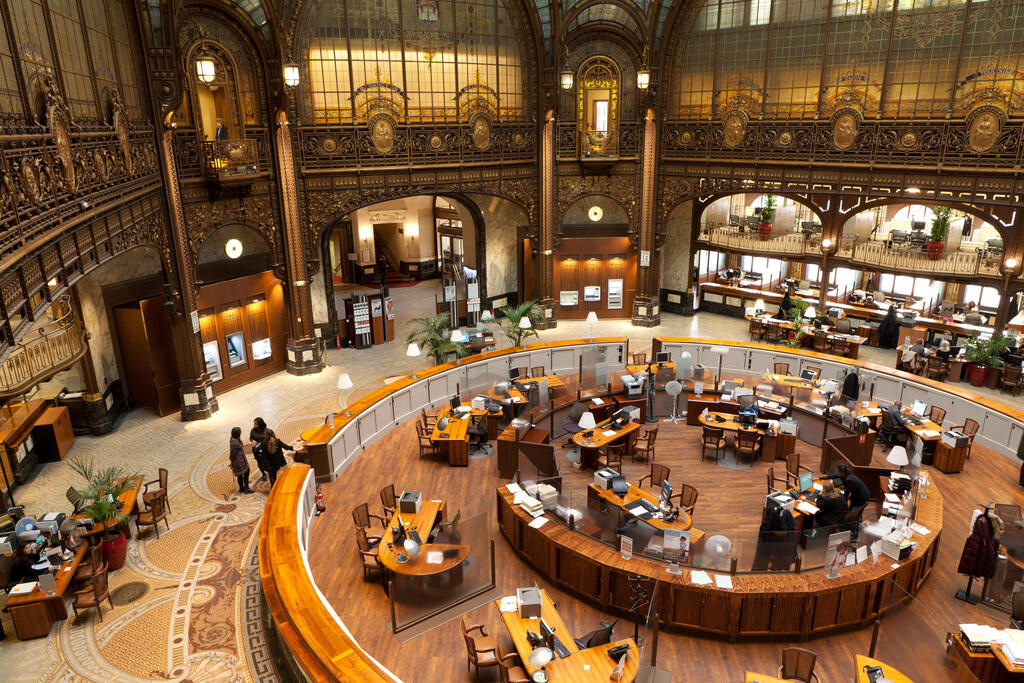
The dome was made by master glassmaker Jacques Galland. It rises to a height of 23 metres and its central rosette has a diameter of 18 metres. It overlooks the large counter encircling open plan offices. The dome is fixed onto an external metal framework, invisible from inside the building.
The dome’s four large arcades feature depictions of France’s four main cities at the time: Paris, Lyon, Marseille, and Bordeaux. Their crests bearing the ‘SG’ monogram are integrated into the dome’s design.
 Inside the Société Générale head office © Photo to be taken by appointment
 Inside the Société Générale © Photo to be taken by appointment
Open on four levels, the spacious central hall is decorated with ironwork motifs of oak leaves, acorns, and acanthus leaves. The mosaic floor was laid by ceramicists Alphonse Gentil and François-Eugène Bourdet. Twelve circular openwork copper plates conceal the heating and ventilation ducts.
 Flooring, mosaic and copper © Photo to be taken by appointment
The vault
Made entirely of steel, the vaults are located on the four basement levels. The deepest one is 11 metres underground. The entrance to the vaults is symbolised by an imposing circular door designed by Fichet. It weighs 18 tonnes! In 1919, a mezzanine was added to accommodate additional offices. The building is listed in the inventory of Historic Monuments by a decree 30 December 1977.
 Vault, 1919 © Charles Lansiaux / DHAAP
Galeries Lafayette
 Contemporary façade of Galeries Lafayette © CAUE de Paris
Originally, the first Galeries Lafayette shop was located at no. 1 Rue Lafayette, hence its name. Théophile Bader and Alphonse Kahn, the two founders, wanted to make fashion accessible to all. When the shop opened in 1894, it was only 70 m². Today, Galeries Lafayette covers over 70,000 m² spread across the buildings on Rue Lafayette, Rue de la Chaussée d’Antin, and Boulevard Haussmann.
 View of Galeries Lafayette © gallica.bnf.fr/Bibliothèque nationale de France
Business extensions and innovations
Initially, sewing supplies were sold there: lace, ribbons, veils, etc. The shop was developing a new kind of trading system including free entry, the possibility to return items, and fixed prices. From 1899 to 1902, the shop expanded across all floors of the building. This marked the start of an extension that would take over the entire block between Boulevard Haussmann and Rue de la Chaussée d’Antin.
 Crowd in front of the entrance to Galeries Lafayette © gallica.bnf.fr/Bibliothèque nationale de France
The ‘luxury bazaar’
In 1912, following these extensions, the great hall was officially opened. This was when Galeries Lafayette became rather spectacular. Illuminated shop windows and an Art Nouveau dome – Théophile Bader dreamed of a ‘luxury bazaar’ where the abundance of luxury the goods would sweep customers off their feet.
 Inside the great hall © Request in progress
 Galeries Lafayette illuminated © gallica.bnf.fr/Bibliothèque nationale de France
A monumental dome
The Art Nouveau dome was created by three artists: Ferdinand Chanut for the structure, Jacques Grüber for the stained glass windows, and Louis Majorelle for the ironwork. The dome, rising to a height of 43 metres, became the symbol of Galeries Lafayette. In 1932, the shop expanded further to Rue Mogador and Rue Provence, to take the form we know today.
 Dome © CAUE de Paris
 Dome © CAUE de Paris
Théâtre Mogador
 Contemporary façade © CAUE de Paris
The future Théâtre Mogador, initially named Palace Théâtre, was built during the First World War under the impetus of Sir Alfred Butt, director of several entertainment establishments in London. He had two aims: to give this theatre to a dancer with whom he was in love and to build a theatre as grandiose as those in London in Paris.
Built on former stables, the work was carried out by engineer Bertie Crewe and architect Édouard-Jean Niermans, who continued to build the theatre despite the challenges of the time and the bombings of the war.
 Photograph of the theatre, 1919 © Charles Lansiaux/DHAAP
The façade was made from Carrara sandstone, manufactured in London by Doulton. The theatre was fitted with the latest developments of the time: two balconies with wide cantilevers and a removable skylight, inspired by London music halls.
 Programme from 1929 © gallica.bnf.fr/Bibliothèque nationale de France
The theatre opened its doors in 1919, in the presence of US President Woodrow Wilson. After an initial success, the theatre ran into difficulties: it was expensive, unprofitable, and had difficulty standing out among all the establishments that opened during the Roaring Twenties. In 1920, the Palace Théâtre was renamed Théâtre Mogador. Several personalities performed there, such as Mistinguett and Offenbach.
Today, the theatre has found its niche on the Parisian scene.
Église de la Sainte-Trinité (Church of the Holy Trinity)
 Detail of the top of the bell tower © CAUE de Paris
Listed as a Historic Monument since 2016, the Église de la Sainte-Trinité is one of the landmarks of the 9th arrondissement.
 View of the church, 1919 © Charles Lansiaux / DHAAP
To support the area’s development and the growing number of Catholic worshippers, in 1861 the City of Paris decided to build the Église de la Sainte-Trinité . It is located at the end of Rue de la Chaussée d’Antin and is crowned by an octagonal bell tower, which makes it visible from miles around.
 Photograph, © Ville de Paris / BHVP, CPA-4098/
 Photograph by Noël Le Boyer, AP43LE17536 © Ministère de la Culture (France), Médiathèque du patrimoine et de la photographie, diffusion GrandPalaisRmn Photo
Its construction was entrusted to architect Théodore Ballu, the 1841 winner of the Grand Prix de Rome scholarship. The architect accentuated the church’s perspective by adding a forecourt: square d’Estienne-d’Orves. This elliptical square, planted with an English garden and enclosed by a stone balustrade, formed the base of the building.
Access the journey
 Bus
Bus
Havre - Caumartin (line 32)
Haussmann - Mogador (line 68)
Gare Saint-Lazare (lines 20, 26, 29, 42, 43, 80, 94)
 Metro
Metro
Chaussée d'Antin Lafayette (line 7)
Havre - Caumartin (line 9)
Saint Lazare (lines 3, 12, 13, 14)
 RER
RER
Haussmann Saint-Lazare (line E)
Auber (line A)
 Vélib'
Docking point no. 9104
Caumartin - Provence
Docking point no. 8009
Gare Saint-Lazare - Isly
Docking point no. 9116
Victoire - Chaussée d'Antin