

Le Marais and Saint-Paul village
 4ᵗʰ arrondissement
🇬🇧 This journey has been automatically translated from its original french version. The translation may be inaccurate.
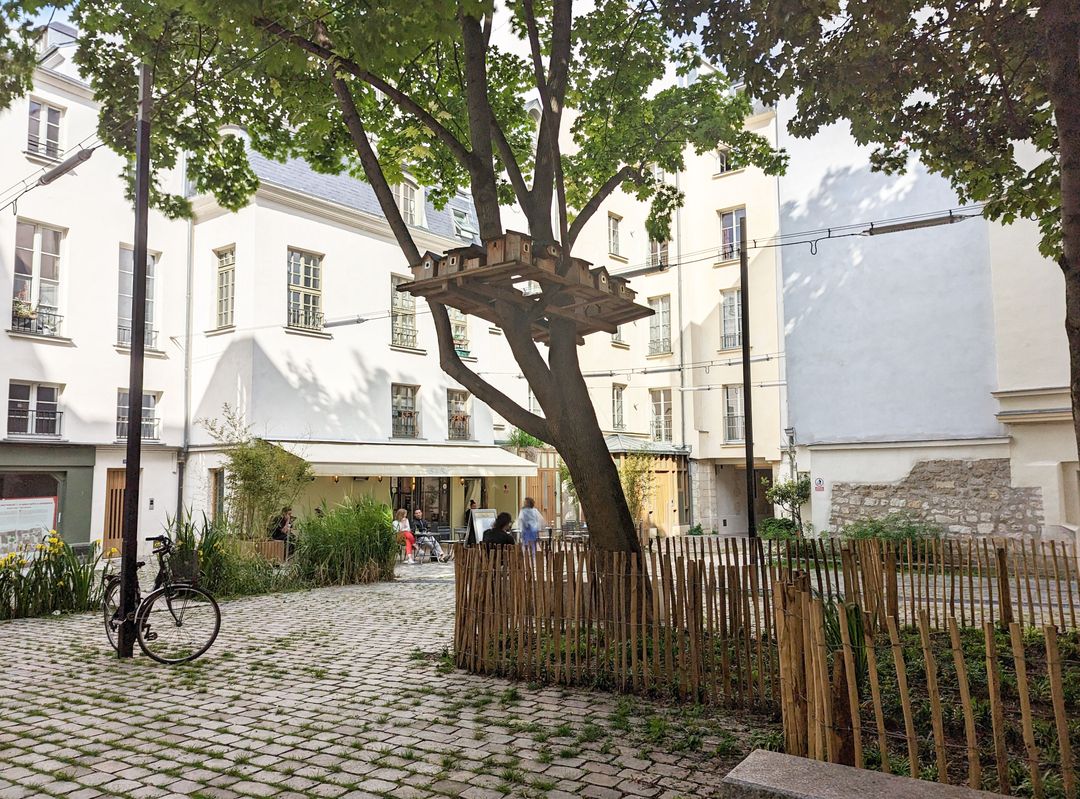
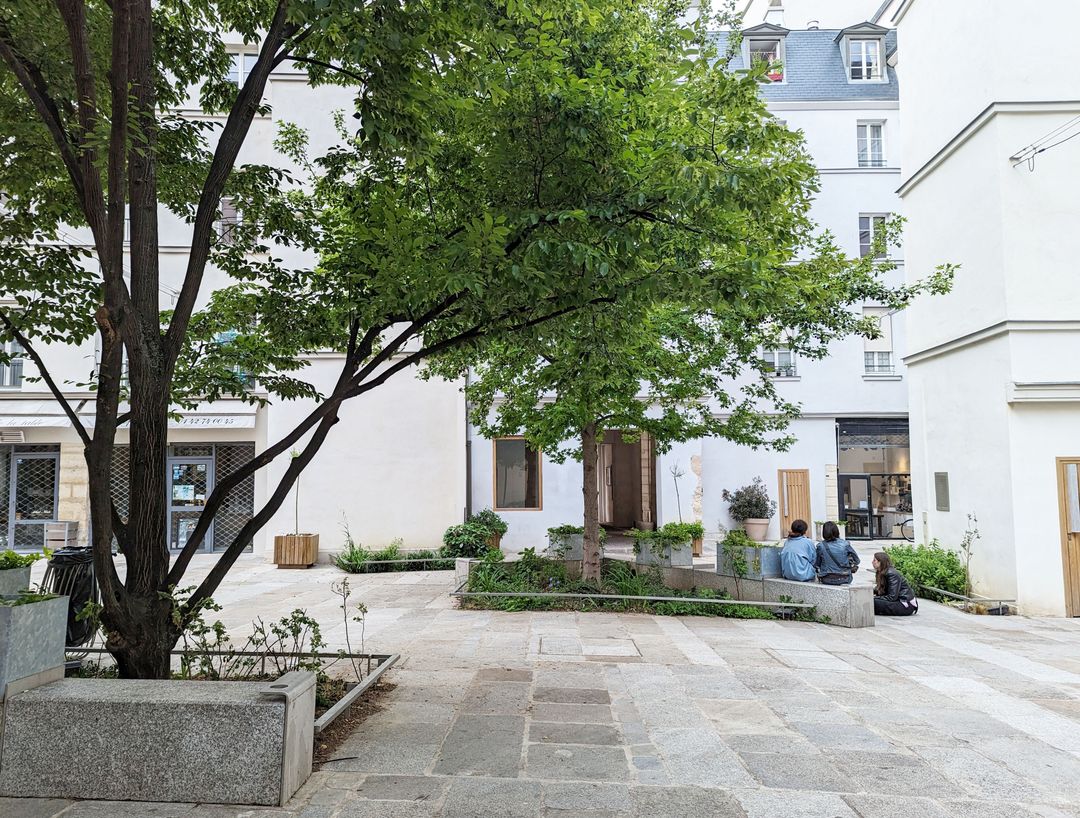
This walk invites you to discover the village of Saint-Paul and its surroundings. Built in the Middle Ages, the neighborhood has undergone several renovations over time to become the peaceful place it is today and adapt to the challenges of climate change.
Will you be able to find traces of the historic past of the district and differentiate them from new developments?

Want to discover the journey ?
For total immersion, download our app and start the journey now!


Journey preview
The Oasis schoolyard of Neuve Saint-Pierre school
 © CAUE de Paris
To deal with heatwave phenomena in the city, and to adapt playgrounds to the needs of children, the City of Paris has decided to transform, little by little, school playgrounds into Oasis courses.
 Courtyard of the Neuve Saint-Pierre school before work © CAUE de Paris
This is the case of the courtyard of Neuve Saint-Pierre elementary school, which was transformed in 2019. Result: much more vegetation, better management of rainwater, more and more varied games, woven huts and a new cool space in the city!
Another special feature: the courtyard is open to everyone on Saturday. This provides local residents with additional play space in the neighborhood!
 Another example of an Oasis courtyard, Émeriau elementary school, Paris 15ᵉ © CAUE de Paris
More content
The Oasis schoolyard of Neuve Saint-Pierre school
© CAUE de Paris
To deal with heatwave phenomena in the city, and to adapt playgrounds to the needs of children, the City of Paris has decided to transform, little by little, school playgrounds into Oasis courses.
Courtyard of the Neuve Saint-Pierre school before work © CAUE de Paris
This is the case of the courtyard of Neuve Saint-Pierre elementary school, which was transformed in 2019. Result: much more vegetation, better management of rainwater, more and more varied games, woven huts and a new cool space in the city!
Another special feature: the courtyard is open to everyone on Saturday. This provides local residents with additional play space in the neighborhood!
Another example of an Oasis courtyard, Émeriau elementary school, Paris 15ᵉ © CAUE de Paris
More content
The brick building on rue Saint-Paul
 © CAUE de Paris
This red brick building, located at the corner of Passage Saint-Paul and built in 1935, contrasts with the other buildings on the street, covered with a white coating. Sometimes horizontal, sometimes vertical, sometimes protruding, here we had fun arranging the bricks in such a way as to create relief and patterns on the facade.
 © CAUE de Paris
Six floors high, the building is particularly narrow and has only two windows per level. From the second floor, part of the building juts out onto the street to align with the facade of the neighboring building. The interior surface area of the accommodation is thus increased by a few precious centimeters!
More content
The courtyards of Saint-Paul village
 © CAUE de Paris
This very old district dates from the Middle Ages and developed in particular with the installation, in the 14ᵗʰ century, between the streets of Saint-Paul, Saint-Antoine, du Petit Musc and the quays, of the royal hotel of King Charles V known as Hôtel Saint-Paul.
Previously located outside Paris, the Marais district was integrated into the city following the construction of the Charles V enclosure. Courtiers, merchants and artisans then settled around the royal residence. The number of inhabitants increases and new buildings are built.
Around 1550, a hundred years after its construction, the Hôtel Saint-Paul was demolished and streets were built on its site. Place Royale, currently Place des Vosges, will become the new heart of the district under Henri IV. Many private mansions were then built in the surrounding area.
The district did not survive the French Revolution of 1789. Most of the hotels were abandoned, sold or seized. The district was then greatly remodeled: the hotels were transformed and divided into several housing units, the surface area of the courtyards was reduced to accommodate artisan workshops and certain buildings were also raised.
 Courtyard of building with open carriage door, 25 rue Saint-Paul, A. Cayeux, 1941-1943 © Paris Musées / Musée Carnavalet - Histoire de Paris
In very poor condition in the 1950s, the area was considered unsanitary and the buildings were threatened with destruction.
 © CAUE de Paris
It was finally saved and restored in the 1970s and 1980s. Some buildings were nevertheless destroyed, to leave more space and light in the interior courtyards. These are today connected by covered passages which pierce the buildings on the ground floor. Everyone can now walk there!
The Saint-Paul village was renovated a second time in 2021. Will you be able to spot the new developments?
 © CAUE de Paris
More content
Shops on the ground floor, housing on the upper floors
 © CAUE de Paris
To bring the neighborhood to life, shops, art galleries and restaurants have been set up on the ground floor of the buildings. Today, the Saint-Paul village is home to around 80 shops. They are open both to the interior of the courtyards and to the exterior streets.
On the upper floors, there are apartments. 243 social housing units have just been renovated: the facades have been repainted and the insulation of the buildings has been improved so that it is less cold in winter and less hot in summer. By using less heating, we save energy!
 © CAUE de Paris
More content
The rain garden of the Rabelais courtyard
 © CAUE de Paris
Today, the soils of our cities are increasingly artificial: parking lots, tar floors, asphalt sidewalks... All these materials are waterproof and therefore do not allow rainwater to infiltrate . Result: the sewers become clogged, vegetation cannot grow and the temperature of the city rises.
 © CAUE de Paris
When the Saint-Paul village was renovated in 2021, new natural spaces were created, including this garden also called rain garden. A rain garden is a very special garden! In fact, it allows rainwater to be collected so that it can then infiltrate directly into the ground. We then say that the soil is permeable.
More content
Rue des Lions-Saint-Paul
 Hôtel Saint-Paul, postcard © Bibliothèque Historique de la Ville de Paris
The Hôtel Saint-Paul having been built between the streets Saint-Paul, Saint-Antoine, du Petit-Musc and the quays of the Seine, the current rue des Lions-Saint-Paul was on its site. Here was actually the royal menagerie. We could admire wild animals there and among them, lions! From there, the very particular name of the street would come.
To honor them, lions were painted in 1364 on the main door of the hotel.
More content
Rives de Seine park
 * © CAUE de Paris*
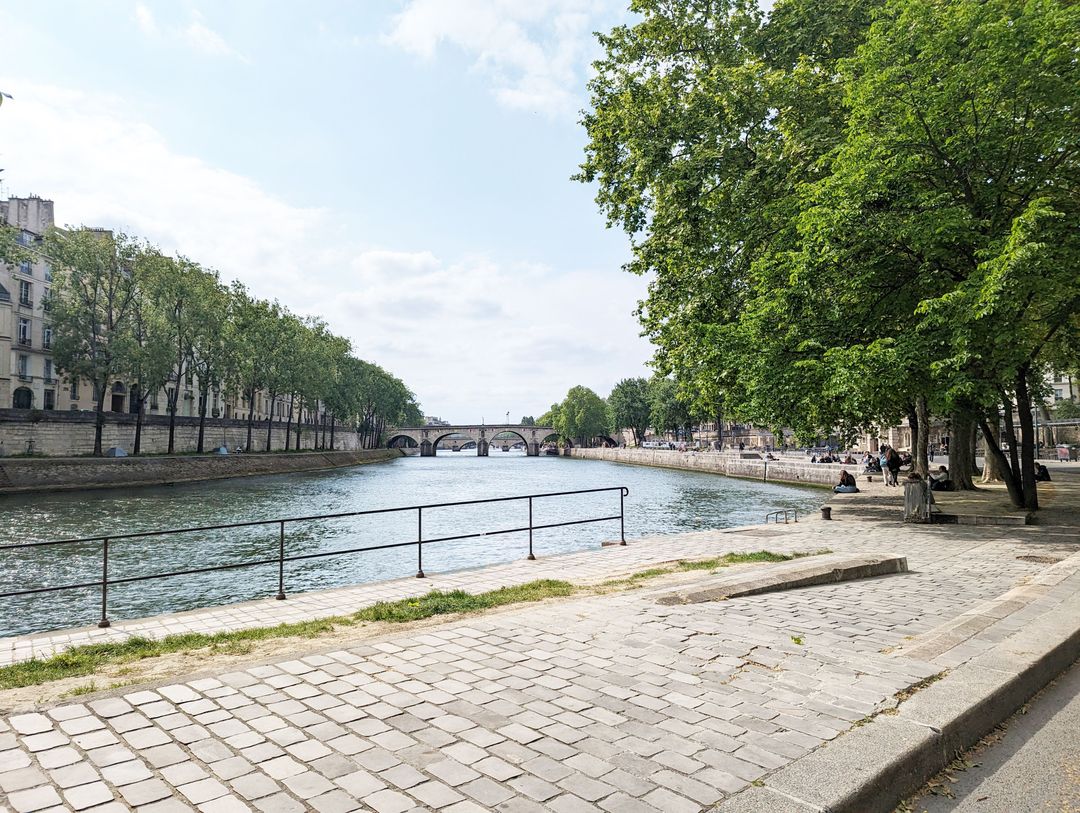
The Seine is a vital river for Paris since it is around which the city was built. First exploited for the transport of goods and the development of artisanal activities, the Seine was then used by Parisians as a place of relaxation and leisure (swimming, fishing, etc.).
 Horse bathing on a Sunday at Pont Sully, E. Pottier, M-J. Léon, 1905 © Paris Musées / Musée Carnavalet - History of Paris
At the beginning of the 20th century, an expressway was built at the quays. Like a highway, this bank lane dedicated to cars no longer left room for pedestrians.
▶️ 1967: the tracks on the bank, an INA document.
 © CAUE de Paris
It didn't last! In 2017, the Rives de Seine park was created. Today it hosts planted spaces, sports courses, play areas, floating gardens...
 © CAUE de Paris
There are also climbing walls, swings and even courses to test and develop your balance. You can get around on foot or by bike.
 Boat powder arrested and docked at the Saint-Paul port, August 6, 1789, J.L. Prieur © Paris Musées / Musée Carnavalet - Histire de Paris
The building in front of you, the Maison des Célestins, is an old river building built in 1837. Recently rehabilitated, it now houses a bar-restaurant.
 © CAUE de Paris
More content
The Hôtel de Sens
 © CAUE de Paris
A vestige of medieval civil architecture, the Hôtel de Sens was built between 1475 and 1519 by the Archbishop of Sens, Tristan de Salazar. Often called to Paris as personal advisor to the kings of France, he had this private mansion built, resembling a fortified castle.
 Hôtel de Sens, 1867, A. Maignan © Paris Musées / Musée Carnavalet - Histoire de Paris
The hotel was sold as national property in 1790 and transformed by its successive owners. It was then occupied by a rolling company, then a laundry, a canned food factory, a hare hair cutter, an optician, a jam factory and finally a glassware depot.
The building was classified as a Historic Monument in 1912 and purchased by the City of Paris in 1916. Restored from 1930 to accommodate, since 1961 it has housed the Forney library, dedicated to decorative arts and crafts. art, fine arts and graphic arts.
Today, only the turrets, the square keep and the portal are original.
 © CAUE de Paris
At the foot of the building, the garden, laid out in the 1950s, houses a labyrinth of low hedges forming clear geometric patterns, in the spirit of 17th century French gardens. It is also accessible via rue des Nonnains d'Hyères.
More content
The Saint-Paul gardens sports field
 © CAUE de Paris
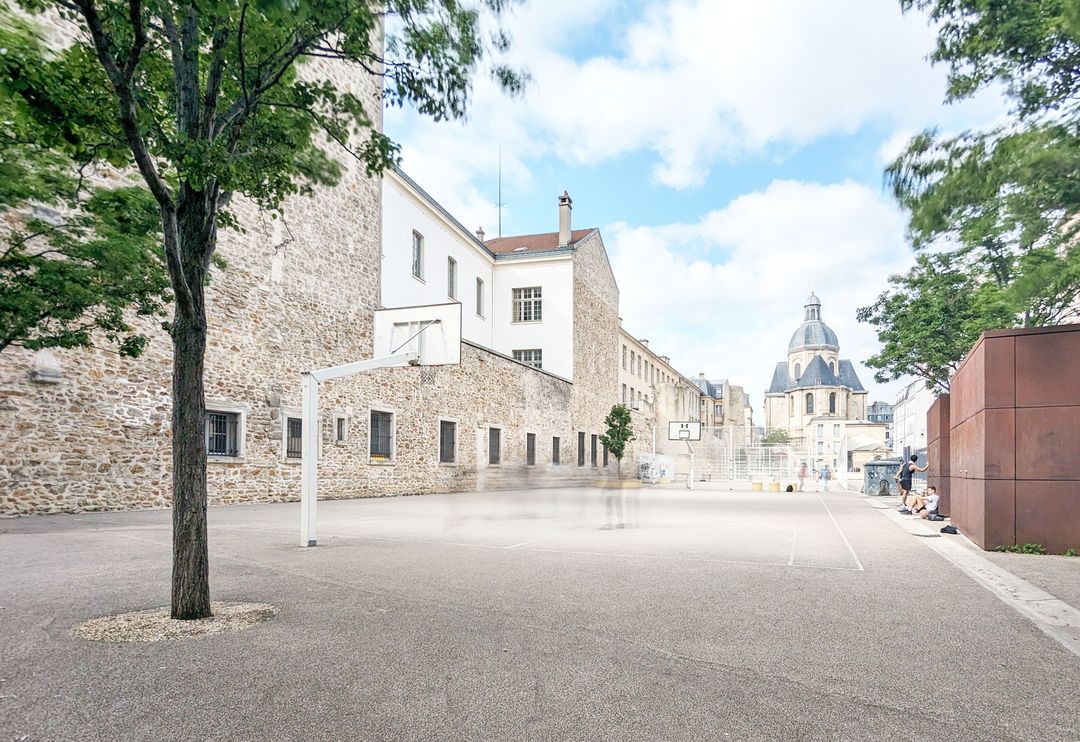
The wall which runs along the sports field is the longest still existing part of the Philippe-Auguste enclosure. This ancient fortification of Paris, built between 1190 and 1220, surrounded Paris, crossing the current 1ˢᵗ, 4ᵗʰ, 5ᵗʰ and 6ᵗʰ arrondissements.
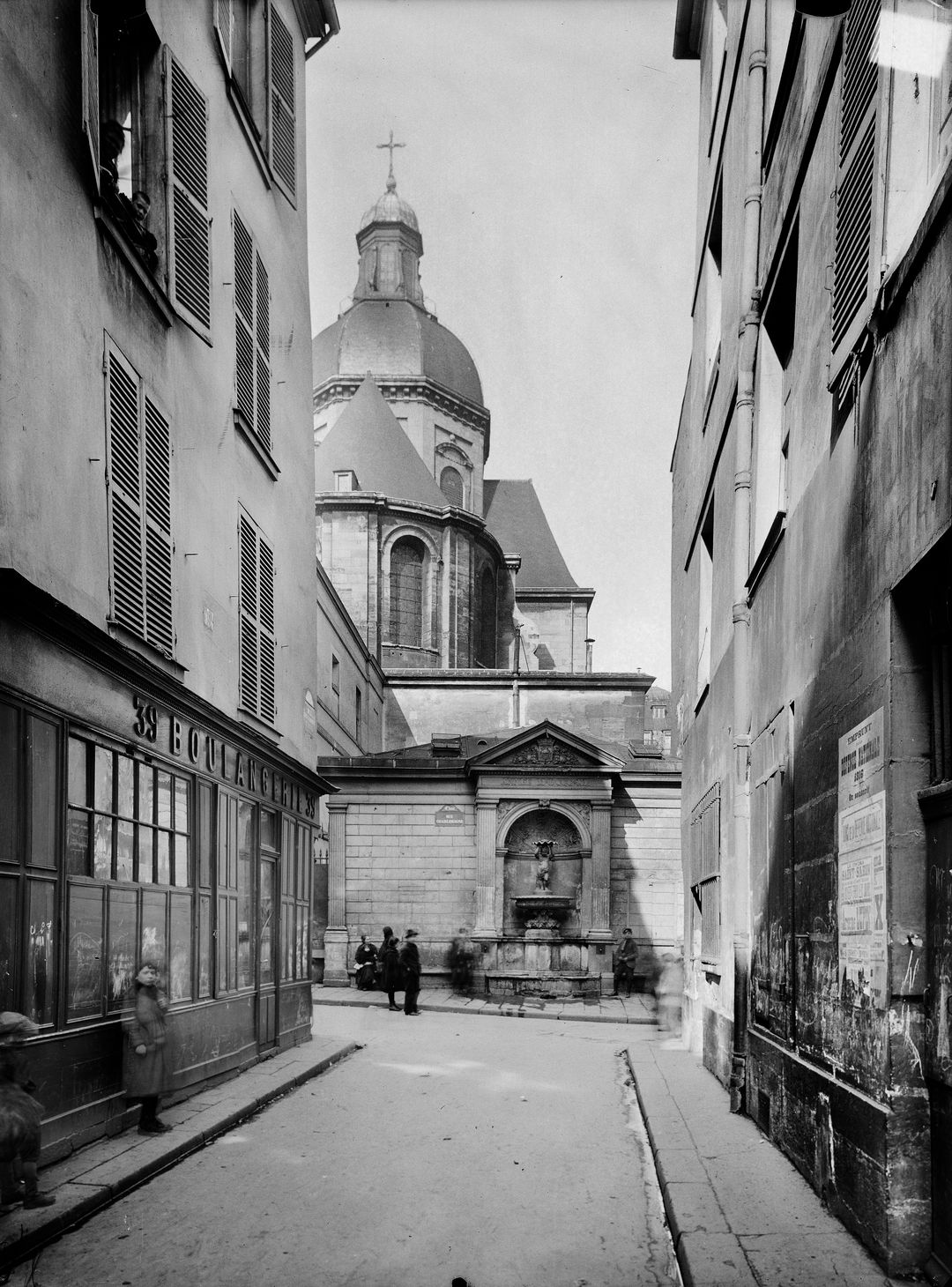 A corner of rue des Jardins-Saint-Paul, 1914, E. Atget © Paris Musées / Musée Carnavalet - History of Paris
Never completely demolished, we can still observe two towers of the wall. This enclosure will be declassified in the middle of the 14th century with the construction of the enclosure of Charles V.
 © CAUE de Paris
In 2016, the architectural agency NP2F was commissioned to rethink the layout of the sports field. A 100-meter track, basketball court, volleyball court, tennis court, five-a-side football and sports initiation area for the little ones, this TEP is aimed at all levels and all ages.
Rue du Prévôt
 © CAUE de Paris
Rue du Prévôt, formerly called rue Percée, is particularly narrow.
 Rue du Prévôt, between 1885 and 1925, E. Atget © Paris Musées / Musée Carnavalet - Histoire de Paris
If this is so, it is because it was not transformed during Haussmann's major renovations in the 19ᵗʰ century.
It thus gives a nice overview of the urban landscape of central Paris at the beginning of the 17ᵗʰ century.
More content
Saint-Paul metro square
 133 rue Saint-Antoine, March 1917 © Charles Lansiaux / DHAAP
This square is the liveliest place in the neighborhood, with shops, many of which are “local”, such as bakeries, a butcher, mini-markets, etc. There is also the Saint-Paul metro station which serves the neighborhood.
 © CAUE de Paris
Since May 2020, rue de Rivoli has been reserved for buses and taxis, but especially for bicycles and pedestrians. You can easily reach Place de la Bastille and Place de la Concorde by bike.
More content
Side activities

Access the journey
 Bus
Bus
Saint-Paul (lines 69, 76 and 96)
 Metro
Metro
Saint-Paul (line 1)
 Vélib'
Neuve Saint-Pierre - Beautreillis (station no. 4110)