

The 20th arrondissement : an urban planning laboratory
 20ᵗʰ arrondissement

🇬🇧 This journey has been automatically translated from its original french version. The translation might be inaccurate.
Discover the diversity of urban planning and architectural trends in recent history, thanks to this walk in the 20ᵗʰ arrondissement! The CAUE of Paris invites you to explore the projects that have made it a true laboratory of social urban planning since the 20ᵗʰ century.

This journey was created in partnership with the CAUE of Île-de-France and with the support of the Direction Régionale des Affaires Culturelles, as part of the Archipel Francilien collection.
We recommend to do this route on Sunday afternoon to have access to the roof garden indicated in stage 7 of the route.
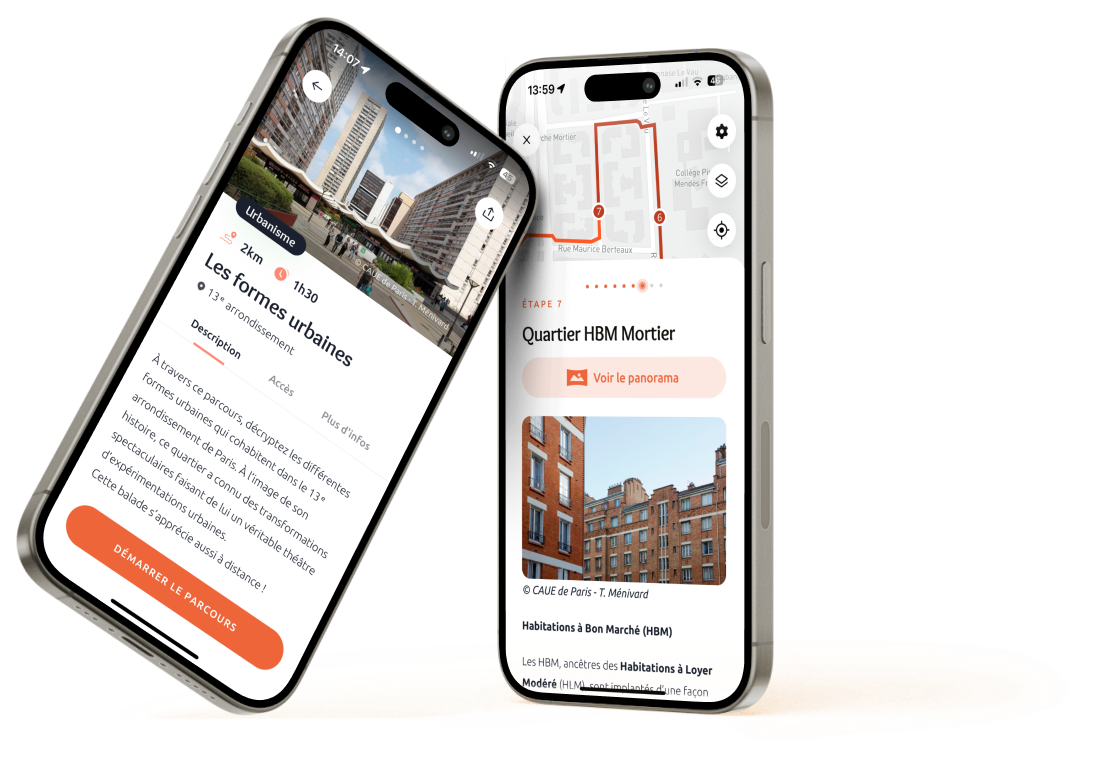
Want to discover the journey ?
For total immersion, download our app and start the journey now!


Journey preview
La campagne à Paris
 Iconic vision of the district © CAUE de Paris - T. Ménivard
A working town between city and nature
Built between 1911 and 1928 on the model of English “garden cities”, this subdivision – called the “Countryside in Paris” – was designed to combine the qualities of the city and those of the countryside in the same place.
 Between city and countryside © CAUE de Paris - T. Menivard
This popular neighborhood today was originally built for working-class populations. Previously occupied by agricultural land and quarries, it was a cooperative created at the initiative of Pastor Sully Lombard who took over the land to build this innovative housing development with a solidarity aim.
 The millstone houses © CAUE de Paris - T. Ménivard
The individual houses each benefit from their garden, and are designed by the architect Pierre Botrel, based on English and Alsatian inspirations. Originally, early childhood facilities were also to be set up to support working families: orphanages, schools, dispensaries, etc. In this way, this operation reflects the philanthropic movement of the early 20ᵗʰ century.
 Detail of a facade © CAUE de Paris - T. Ménivard
La campagne à Paris
Iconic vision of the district © CAUE de Paris - T. Ménivard
A working town between city and nature
Built between 1911 and 1928 on the model of English “garden cities”, this subdivision – called the “Countryside in Paris” – was designed to combine the qualities of the city and those of the countryside in the same place.
Between city and countryside © CAUE de Paris - T. Menivard
This popular neighborhood today was originally built for working-class populations. Previously occupied by agricultural land and quarries, it was a cooperative created at the initiative of Pastor Sully Lombard who took over the land to build this innovative housing development with a solidarity aim.
The millstone houses © CAUE de Paris - T. Ménivard
The individual houses each benefit from their garden, and are designed by the architect Pierre Botrel, based on English and Alsatian inspirations. Originally, early childhood facilities were also to be set up to support working families: orphanages, schools, dispensaries, etc. In this way, this operation reflects the philanthropic movement of the early 20ᵗʰ century.
Detail of a facade © CAUE de Paris - T. Ménivard
The Jouye-Rouve et Taniès dispensary
 The dispensary today © CAUE de Paris - T. Ménivard
Hospitable architecture
A health establishment intended to provide care to low-income populations, this 20th century equipment is an example of social innovation.
 The dispensary in 1914 © Gallica-BNF
Fighting against tuberculosis
The dispensary is fully part of urban hygienist thinking which developed at the beginning of the 20ᵗʰ century, in order to fight against the tuberculosis epidemic. After a vast study on mortality was carried out at the initiative of the public authorities, it appears that the development of tuberculosis is caused in particular by the unsanitary conditions of entire neighborhoods, and more particularly by the lack of sunlight in housing. .
 Panel dating from 1900 © Gallica-BNF
An example of social innovation
The sun being considered at the time as one of the remedies against this disease, it then became a real urban planning tool. Ventilation and sunshine are the key words of hospital architecture which is also reflected in housing (HBM) and equipment (baths-showers).
 The old baths -showers adjoining the dispensary © CAUE de Paris - T. Ménivard
Giving access to care for all
It is in this context that dispensaries are created, in order to provide care to young children. This one, made of millstone, was built in 1910 by the architect Louis Bonnier. This building now benefits from heritage protection under the Paris urban plan.
The Fontarabie-Bagnolet block
 Entrance from rue Fontarabie © Martin Argyroglo
Making architecture a city
This mixed program residence, dating from 1984 and designed by the architect Georges Maurios on the commission of the Régie Immobilière de la Ville de Paris (RIVP), is a very characteristic example of urban architecture practiced in the 1980s. finds references to the traditional city developed on the scale of an architectural project.
 A perspective in the heart of the block © Martin Argyroglo
A street allows you to cross between the two buildings and widens into a small square in the heart of the plot. Spaces for meetings and sociability are thus created for the residents of these social housing units and the daycare center. In addition, the columns on the facade, as well as the differentiated work of the base and the crowning, refer to the principles of traditional architecture.
The Fréquel-Fontarabie ecodistrict
 The place in the block center. View from rue de Fontarabie © CAUE de Paris - T. Ménivard
From unsanitary housing to ecodistrict
The Fréquel-Fontarabie ecodistrict comes from the reconversion of a former industrial wasteland. In order to combat unsanitary housing, the City of Paris commissioned SIEMP to restructure this district from the beginning of the 2000s. 109 housing units, public facilities, a garden and shops were delivered in 2015.
 Traces of an ancient passage © CAUE de Paris - T. Ménivard
Located in a suburban urban fabric, the urban ambition coordinated by Eva Samuel is based on the conservation of traces of this past in the building typologies: the heights of the buildings, the locations and even the system of passages are recreated. However, a contemporary expression is identifiable in the diversity of materials, colors and facade coverings of the architecture.
 The diversity of materials © CAUE de Paris - T. Ménivard
In addition, it is through its ecological dimension that the operation is resolutely anchored in its time. More precisely, the Ecodistrict Label distinction implies commitments concerning energy, waste and water.
 Vegetation © CAUE de Paris - T. Ménivard
This ecodistrict received the prize in the “energy sobriety” category in the eco-district competition (2009), and the “ecodistrict” label trophy from the Ministry of Territorial Equality and Housing (2013).
Double-skin building
 View from rue des Orteaux © CAUE de Paris - T. Ménivard
A bioclimatic architecture
This operation of 20 social housing units, delivered in 2013 by the Babled Nouvet Reynaud Architectes agency, is part of the Paris Climate Plan, at the initiative of SIEMP.
 The double glass skin © CAUE de Paris - T. Ménivard
The agency wanted to propose a so-called “bioclimatic” architecture, which relies on solar input and natural ventilation to offer thermal comfort to residents, limiting the use of polluting means (heating, air conditioning). For this, the 20 housing units are located to have the best exposure to the sun, and each benefit from a “double skin” made of glass to heat the incoming air.
 The interior gardens © CAUE de Paris - T. Ménivard
The buildings are also through, thus promoting air circulation and ventilation of the accommodation. The operation benefits from the “High Environmental Quality” (HQE) label and received the Équerre d’Argent architectural prize in 2013.
The Réunion block
 View from rue des Hurdles © CAUE de Paris - T. Ménivard
Developing a historic district
The Réunion development zone is an urban renovation operation piloted by the RIVP between 1997 and 2004. The complexity of this project was to fit into a very constrained historic urban fabric, while meeting ambitious programmatic objectives in terms of housing creation. Indeed, this district is characteristic of the old villages and suburbs of Paris: its formerly agricultural plots are strips, narrow and deep.
 The ancient villages around Paris. Cassini map, 18ᵗʰ century © Géoportail
Ultimately, it was chosen to preserve and rehabilitate certain historic buildings and build new ones, inspired by the historical traces and the history of the place. References to suburban architecture are found in the low heights of the buildings, their white color, and the pedestrian passages and alleys.
 View of the Dagorno passage © Martin Argyroglo
This operation, entrusted to the architect Philippe Prost, is representative of urban thinking particularly attentive to the formerly peripheral urban fabrics of Paris which developed in the 1990s.
A garden on the roof
 View from the gymnasium street on the left © Martin Argyroglo
Promoting a solidarity initiative
The operation designed by TOA Architectes follows a competition launched in 2004 by Paris Habitat, the objective of which is to build 40 social housing units and a gymnasium.
 View from the roof © CAUE de Paris
The difficulty of this project then lies in the fact of installing equipment with very constrained and imposing dimensions (the 44x24 meter gymnasium) in a stripy suburban urban fabric, originating from the agricultural past of the district.
 The roof of the cultivated gymnasium © CAUE de Paris
An association lived on site with a community garden, awaiting development of the site. In order to maintain this initiative, the agency proposes to install the garden on the roof of the gymnasium, thus offering interesting views to the surrounding accommodation. In this way, the neighborhood social bond and the environmental issue are preserved in the development operation.
The bains-douches
 The main facade © Martin Argyroglo
An architectural archetype
These public baths, called bains-douches in french, prefigure the model of hygiene equipment associated with workers’ housing. In the same way as dispensaries and Habitations à Bon Marché (affordable housings), public baths are representative of an urban thinking which developed at the beginning of the 20ᵗʰ century which we qualify as hygienist.
 The facade layout © Martin Argyroglo
In 1927, architects Henri Gautruche and Georges Planche delivered this first collective facility, so that nearby residents could have regular toilets. The choice of brick was necessary for economic reasons (low maintenance cost), in the same way as for a large number of hygienist architectures of the time.
 Advertising dating from 1901 © Gallica BNF
Twelve facilities of this type will subsequently be built on this model in Paris. This was already an innovation for the time, even if the individual bathroom would not arrive in all Parisian homes until much later.
Habitations à Bon Marché, Lagny-Loliée block
 View of entire residential building © Martin Argyroglo
A family story
This housing program was designed by the architects of the Lesage et Miltgen agency, based on the competition launched by the City of Paris. The Lesage family is a family of architects who, over three generations, have built many remarkable buildings in the Parisian landscape.
 The Saint-Mandé factory in 1880 © Gallica BNF - école nationale des ponts et chaussées
A place with an industrial past
It is located on land historically occupied by the Saint-Mandé gas factory, surrounded by the Petite Ceinture railway and the Thiers fortifications (current ring road).
 The Saint-Mandé factory in 1880 © Gallica BNF - école nationale des ponts et chaussées
A land opportunity
When the factory closed, the Habitations à Bon Marché (HBM) – affordable housings – were built in 1935, in response to the high demand for housing.
Iconic homes
Designed on the model of a philanthropic city, HBMs are the first social housing in the City of Paris. Easily recognizable by their brick cladding and their location along the boulevards of the Maréchaux, they are emblematic of the hygienist thinking of the time: the buildings were designed to allow ventilation and sunlight into the homes.
 HBM exhibition in 1903 © Gallica BNF
Avenue de la Porte-de-Vincennes
 View from one side of the road axis © Martin Argyroglo
Staying at the gates of Paris
These social housing units were built between 1955 and 1959 by the SCIC, and designed by architects Pierre-Henri Bailleau, Jean Michel Legrand and Jacques Rabinel.
An entry into Paris
The strategic location of this operation, at the entrance to Paris, on the historic axis of the city, is undoubtedly the origin of its monumentality. Indeed, the buildings are imposing in their number (eight), their symmetry on either side of avenue de la Porte-de-Vincennes, and their height of 10 floors.
 Before construction: the “zone” © Charles Lansiaux - DHAAP
A characteristic project from the 1950s
Allowed by the new post-war urban regulations, favoring modern urban thinking, the buildings are arranged perpendicular to the avenue, thus providing a prominent place for green spaces on the ground floor. Through the sobriety of the volumes and the constructive choices (reinforced concrete structure and stone facing), this operation is fully in line with the urban thinking of its time.
 The green ground floors © Martin Argyroglo
Access the journey
 Tramway
Porte de Bagnolet, exit 2 Boulevard Mortier (Tram T3B)
 Metro
Metro
Porte de Bagnolet, exit 2 Boulevard Mortier (line 3)
 Vélib'
Station n°20022 (Porte de Bagnolet)