

From the wall of the Ferme Générale to the bastion of Thiers
 14ᵗʰ arrondissement
🇬🇧 This journey has been automatically translated from its original french version. The translation might be inaccurate.
Explore the 14ᵗʰ arrondissement, from one precinct to another. From the old grant barrier from 1785 in Denfert-Rochereau, to the last vestiges of the Thiers enclosure from 1840 at the Cité Internationale Universitaire, stroll in the shade of the plane trees on Avenue René-Coty and discover the history and heritage that shaped the urban landscape of the ancient village of Montrouge.

Want to discover the journey ?
For total immersion, download our app and start the journey now!


Journey preview
Barrière d'Enfer
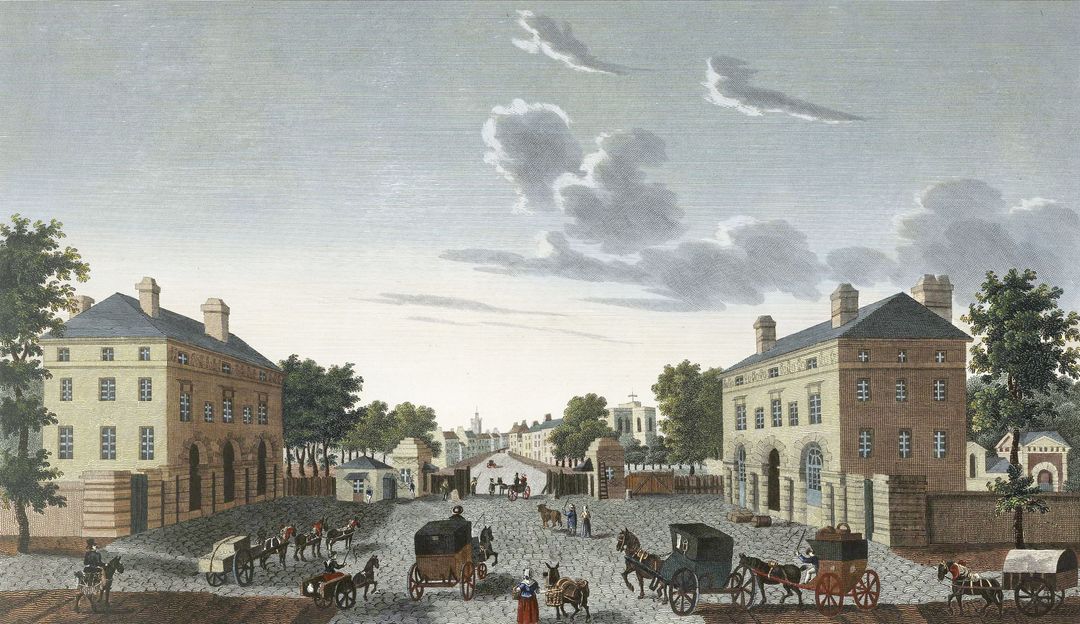
 La barrière d'Enfer 1819 - watercolor etching by Palaiseau © Gallica BnF
You are facing the two pavilions of the Barrière d'Enfer (Hell Barrier), the former granting barrier of the General Farmers enclosure. At the end of the 18th century, the Farmers General were responsible for collecting taxes on goods entering Paris. To fight against fraudsters and smugglers, it was decided to extend the boundaries of the capital and replace the modest wooden palisade with a stone wall three meters high and 24 km long. The route of this wall, built between 1784 and 1791 in the countryside, today corresponds to lines 2 and 6 of the aerial metro.
 New road plan for the City and Suburbs of Paris, with its Main Buildings and New Barriers - 1789 - Pichon © Gallica BnF
To complete this enclosure and give a monumental character to the gates of Paris, the architect Claude-Nicolas Ledoux designed around fifty monumental gates, in a neoclassical architectural style. He called them the “propylaea of Paris”, in reference to the propylaea of Athens. Only four of these gates still exist today: the rotunda of Parc Monceau, the rotunda of La Villette, the Barrier du Trône, and the two pavilions of the Barrier d’enfer.
 Six barriers grant in 1800 © Antoine-Joseph Gaitte — Jean Valmy-Baysse, La curieuse aventure des boulevards extérieurs, Éditions Albin-Michel, 1950
Built in 1785, the Denfert pavilions were pillaged and burned on July 13, 1789, as were many gates of the grant barrier, symbols of royal power and inequalities. The grant was abolished in 1791 (while the pavilions had just been rebuilt) then reinstated in 1798. The pavilions thus regained their function until 1860 when the grant was moved to the Thiers enclosure. The grant wall was then demolished to create a circular boulevard.
 Pavilion restoration project Ledoux © Artene
The facade of the pavilions is majestic and displays the codes of the neo-classical style (cut stones, arches, bas-relief friezes). On the other hand, the interior spaces were quite simple and only housed offices and staff accommodation.
Until 2017, the site was occupied by the general inspection of quarries and a materials testing laboratory of the City of Paris.
Since 2019, it has hosted the museum of General Leclerc de Hauteclocque and the Liberation of Paris - Jean Moulin museum and the Catacombs museum thanks to an ambitious restoration project led by the Artene agency. Listen to the podcast (in french) produced by the CAUE during a visit to this site
 The east pavilion - entrance to the catacomb museum © CAUE de Paris
More content

Barrière d'Enfer
La barrière d'Enfer 1819 - watercolor etching by Palaiseau © Gallica BnF
You are facing the two pavilions of the Barrière d'Enfer (Hell Barrier), the former granting barrier of the General Farmers enclosure. At the end of the 18th century, the Farmers General were responsible for collecting taxes on goods entering Paris. To fight against fraudsters and smugglers, it was decided to extend the boundaries of the capital and replace the modest wooden palisade with a stone wall three meters high and 24 km long. The route of this wall, built between 1784 and 1791 in the countryside, today corresponds to lines 2 and 6 of the aerial metro.
New road plan for the City and Suburbs of Paris, with its Main Buildings and New Barriers - 1789 - Pichon © Gallica BnF
To complete this enclosure and give a monumental character to the gates of Paris, the architect Claude-Nicolas Ledoux designed around fifty monumental gates, in a neoclassical architectural style. He called them the “propylaea of Paris”, in reference to the propylaea of Athens. Only four of these gates still exist today: the rotunda of Parc Monceau, the rotunda of La Villette, the Barrier du Trône, and the two pavilions of the Barrier d’enfer.
Six barriers grant in 1800 © Antoine-Joseph Gaitte — Jean Valmy-Baysse, La curieuse aventure des boulevards extérieurs, Éditions Albin-Michel, 1950
Built in 1785, the Denfert pavilions were pillaged and burned on July 13, 1789, as were many gates of the grant barrier, symbols of royal power and inequalities. The grant was abolished in 1791 (while the pavilions had just been rebuilt) then reinstated in 1798. The pavilions thus regained their function until 1860 when the grant was moved to the Thiers enclosure. The grant wall was then demolished to create a circular boulevard.
Pavilion restoration project Ledoux © Artene
The facade of the pavilions is majestic and displays the codes of the neo-classical style (cut stones, arches, bas-relief friezes). On the other hand, the interior spaces were quite simple and only housed offices and staff accommodation.
Until 2017, the site was occupied by the general inspection of quarries and a materials testing laboratory of the City of Paris.
Since 2019, it has hosted the museum of General Leclerc de Hauteclocque and the Liberation of Paris - Jean Moulin museum and the Catacombs museum thanks to an ambitious restoration project led by the Artene agency. Listen to the podcast (in french) produced by the CAUE during a visit to this site
The east pavilion - entrance to the catacomb museum © CAUE de Paris
More content
The Lion of Belfort
 Inauguration of the Lion of Belfort on the Place de Denfert-Rochereau in 1880, print by Karl Fichot, © Paris Musées / Musée Carnavalet - Histoire de Paris
The majestic lion, 22 meters long and 11 meters high, is a replica, reduced to a third, of the lion sculpted by Auguste Bartholdi in the pink granite of the Belfort cliff, at the foot of the citadel. They both commemorate the resistance of Colonel Denfert-Rochereau against the Prussians during the war of 1870.
 The Lion of Belfort by Auguste Bartholdi, in Belfort. Photographs from Agence Rol - 1920 © Gallica BnF
The Lion of Belfort has become the symbol of Place Denfert-Rochereau. He even gave his name to a famous funfair installed for more than 50 years on the square, between 1880 and 1930: the Belfort Lion Festival. Roundabouts, lotteries, parades, smart fleas, fortune tellers, phenomena, lion tamers, circuses and theaters attracted crowds to the square and all the roads.
 Lion of Belfort funfair, e Modern cirque Lambert : Photographies de l'Agence Rol - 1920 © Gallica BnF
 Poster for the Lion of Belfort Festival, between 1880 and 1900, designer Alfred Choubrac © Paris Musées / Musée Carnavalet - Histoire de Paris
Denfert-Rochereau station
 Sceaux station, 1880 © BHVP
This station is the oldest in Paris. It was built in 1846 by the architect Alexis Dulong. At the time, it was outside the administrative limits of Paris and marked the departure of the Sceaux line. It originally had two wings, but it lost the right wing in 1895, during work to extend the line into Paris. Its facade is topped by a triangular pediment in which bas-reliefs represent two allegories of the invention of the railway.  ©CAUE de Paris - T. Ménivard
It owes its convex shape to the engineer Claude Arnoux, who founded and operated this line until 1857 and designed it as a demonstrator of his innovative railway system, which made it possible, thanks to articulated trains, to borrow lines with strong curvatures.
 Paris illustré : Guide de l'étranger et du Parisien, 1876, par Adolphe Joanne © Gallica BnF
The station overlooked a rounded platform, serving a single track in the form of a turning loop. This so-called “Arnoux” system allowed considerable time savings, avoiding the complicated maneuvers of turning around locomotives at terminal stations.
 Tableau de Victor Navlet d’après une photo de Nadar © RMN-Grand Palais (musée d'Orsay)/Photo Jean Schormans
This line quickly became a great success, with train departures every hour. The crowds were particularly strong on Sunday, the day of the famous Sceaux ball, passed down to posterity thanks to the news of Balzac. In 1859, the Compagnie des Chemins de Fer de l'Orléanais, which succeeded Claude Arnoux, decided to extend the line between Orsay and Limours via Saint-Rémy-lès-Chevreuse.
 Imagerie commerciale et publicitaire, fonds imprimerie Champenois, 1890 © Bibliothèque Forney
Between 1889 and 1892, the line was extended in Paris to Luxembourg station underground; Port-Royal station was built at this time.
 Sceaux train station, 1914 © BHVP - Fonds Lansiaux
Avenue René-Coty
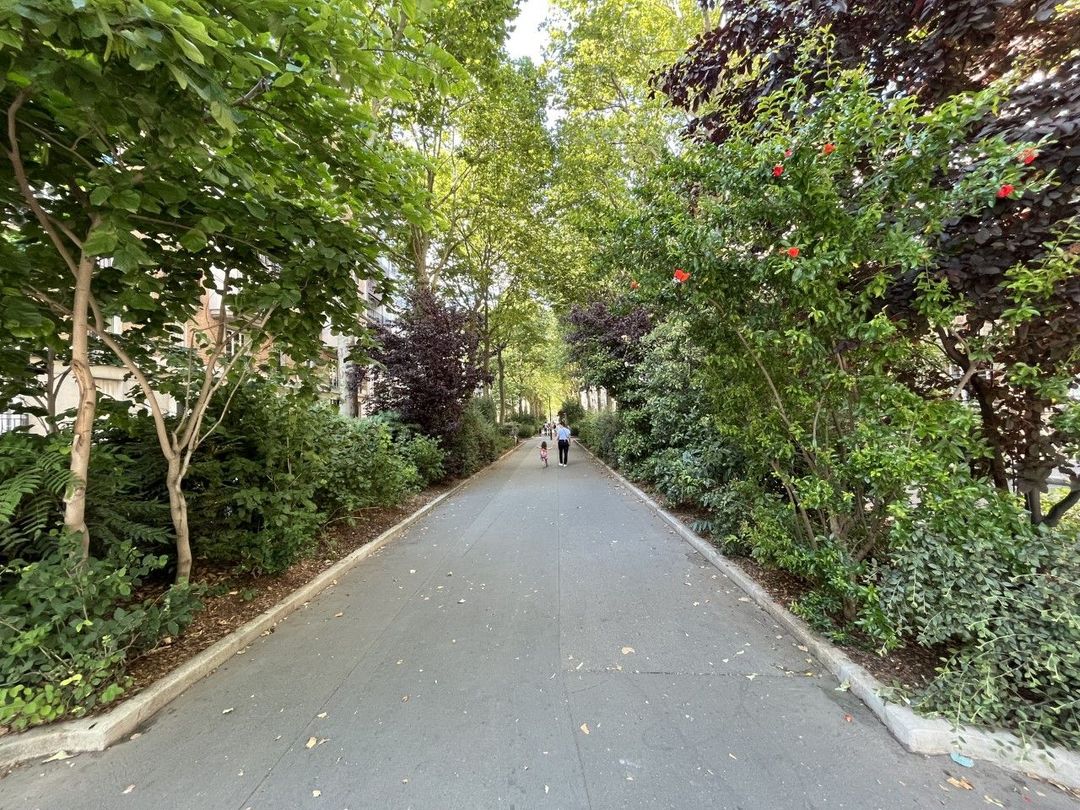
 Allée Samuel-Beckett, photographic competition Landscape portraits © Olivia Auger
You are now embarking on the planted promenade of Avenue de Montsouris, desired by Prefect Haussmann to lead walkers towards his future large Parisian park, Parc Montsouris, created in anticipation of the Universal Exhibition of 1867.
 Children's games on avenue de Montsouris © BHVP
This long avenue of 1,013 m, lined with plane trees and 32 m wide, extends Boulevard d'Enfer (current Boulevard Raspail) to the new park. The expropriations necessary for the creation of this axis also led to the garden of La Rochefoucauld hospital being cut even further than it had already been by the construction of the Sceaux railway line.
 Plan d’expropriation pour l’ouverture de l'avenue du parc Montsouris, 1868 © BHVP
Designed from the outset as a pedestrian promenade, the new avenue is organized as a side alley planted with trees in the middle, bordered by two carriageways for cars, each one-way. The significant difference in height of Montsouris (30 m between the bottom of rue Dareau and Porte d'Arcueil, at the top) made it necessary to cut the avenue into a trench and undertake major excavation and embankment work for all the buildings that border it.
 Avenue du parc Montsouris © BHVP
Initially named “Avenue de Montsouris”, its name was changed to “Avenue du Parc de Montsouris” in 1899, so that people outside the neighborhood would know that it led to the park. It was renamed “Avenue René-Coty” again in 1964, in homage to the 17th President of the Republic. Since 1999, its central avenue has been called “Allée Samuel-Beckett”, in memory of the Irish writer, poet and playwright.
La Rochefoucauld Hospital
 © CAUE de Paris
La Rochefoucauld hospital was founded in 1781 and installed in a house then located in Montrouge, in the countryside, on 22,000 m² of land. This “Royal House of Health” was initially intended for needy ecclesiastics and soldiers. In 1802, it became a retirement home. The establishment was considerably enlarged and the architect of the hospitals of the Crown and the Order of Charity, Jacques-Denis Antoine, was responsible for its reconstruction. The building has been listed in the supplementary inventory of historic monuments since 1928.
 Main plan of the hospital © BHVP
Originally, the vast park with neoclassical design extended to the current Place Denfert-Rochereau and well beyond Avenue René-Coty. It offers residents clean air and opportunities for walks in a beautiful landscape: regular gardens alternate with flowerbeds, paths and quincunxes. The park was cut down over time, by the construction of the line of seals then by the opening of Avenue Montsouris.
The small stone building located in the garden is manhole number 25 of the Medici aqueduct coming from Arcueil, which supplied the hospice with water.
 The “look of Saux” © CAUE de Paris
In 1821, the Royal House of Health took the name of La Rochefoucauld hospice, in homage to its main donor, the Viscountess of La Rochefoucauld. In 1849, the hospice was attached to the Assistance Publique de Paris.
 Photography of the rooms © BHVP
The La Rochefoucauld hospital closed its doors in 2019 to be put up for sale. It is currently temporarily occupied by the police station of the 14th arrondissement.
Exit from the catacombs
 © CAUE de Paris
You find yourself facing the exit of the catacombs. The Parisian ossuary was named in reference to the catacombs of Rome. Entrance is at Place Denfert Rochereau, at 1 avenue du Colonel Henri Rol-Tanguy.
 Ancient entrance to the catacombs barrière d'Enfer © Ville de Paris / BHVP
The 1.7 km and 11,000 m² of labyrinthine galleries house six million bones, coming from different Parisian cemeteries and arranged in these old quarries in a romantic-macabre setting.
 Plan, by the surveyors of the general inspection of quarries, 1857 © City of Paris / BHVP
The route ends in April 2017 in this new outing, designed by the Yoonseux architects agency. The whiteness and volumes of this transitional space made of Corian® accompany the visitor on their return to daylight, after this winding journey under vaults, from 1.80 to 20 m underground.
 Visit of the catacombs © Ville de Paris / BHVP
La Maison maternelle
 © CAUE de Paris - T. Ménivard
The Louise Kopp Foundation Maternal House was built in 1909 by the architects J. Charlet and F. Perrin. The purpose of this foundation was to temporarily and free of charge accommodate young children (3 to 6 years old for boys and 3 to 12 years old for girls) from families in distress. The children were sheltered, fed, bathed, and clothed if necessary. The length of stay could not exceed three months. The foundation also welcomed women in need.
 Meat distribution to unemployed women, Charles Lansiaux © BHVP
Aligned with the avenue, the main building has a facade composed of two floors on the ground floor, topped by an attic floor. The light brick walls are decorated with red bricks and elements of flamed sandstone, creating a sort of “cross stitch” with a deliberately childish character.
The ground floor included the caretaker's accommodation, the parlor, the offices, the refectory and the kitchens, all opening onto a covered courtyard giving access to the playground. The floors were mainly reserved for dormitories with a few study rooms on the first, a laundry room on the second and an infirmary on the third.
 The pantry, Charles Lansiaux © BHVP
Today, the Montsouris house is approved by an agreement with the Paris prefecture under the name “Children’s home of a social nature”. It is open all year round 24 hours a day and accommodates all emergencies. It ensures the reception, accommodation and schooling of young people aged 3 to 16 who are entrusted to it by the Child Welfare services.
Alice Milliat Gymnasium
 © Robert Bernard-Simonet
The Alice-Milliat gymnasium, designed by the architect Robert Bernard-Simonet and the landscaper Yves Deshayes, was delivered in October 2005. The building slipped into a particularly constrained plot and behind a millstone wall and a pre-existing embankment.
These constraints and the need to provide a free height of 10.50 m in the room (at the origin of the program, to create a Basque pelota front, today for one of the largest climbing walls in Paris) led the architect to propose an original constructive solution: a monumental beam, in post-tensioned concrete, spans the length of the gymnasium, i.e. 44 m span by 4.50 m height.
 © Robert Bernard-Simonet
The height of this beam makes it possible to accommodate the changing rooms and technical rooms on the floor thus created, and to carry the garden terrace, accessible from a staircase/belvedere located outside, at the corner of the two streets.
 © Yves Deshayes
Originally designed as a pleasure garden, it has today become a shared garden.

 © Yves Deshayes
Rue des artistes
 The artists’ staircase © CAUE de Paris
This street, opened in 1853, was named « rue des artistes » because this road is a former artists' residence. The painters Claude Rameau and Louis Charlot shared a workshop there at the beginning of the 20th century
 © CAUE de Paris - T. Ménivard
At number 6 of the street, admire the work of the artist Antoine Bertrand entitled MOMIJI “Kingyo and autumn maple leaves” created on October 26, 2019 in paint and copper leaf as part of an order © CAUE de Paris - T. Ménivard
At No. 7 rue Gauguet, a dead end starting rue des Artistes, the architect Marcel Zielinsky built, in 1931, a house-studio for the painter and decorator, Gaston André. This two-story house-studio, designed in the vein of the modern movement, was partly rented to the painter Nicolas de Staël, from 1947. The great height of the workshop allowed him to paint large-scale paintings
 © CAUE de Paris - T. Ménivard
Lemordant workshop-house
 © Agence Meurisse, Gallica BnF
Built in 1929 by the architect Jean Launay, this house-workshop was designed by and for the famous Breton painter Jean-Julien Lemordant, on a particularly constrained plot of land.  © CAUE de Paris - T . Menivard
It is wedged between avenue René-Coty, rue de l’Aude and the 7-meter-high oblique ramparts of the Montsouris reservoir. This narrow, strongly sloping, triangular-shaped plot of land had remained vacant since the creation of Avenue Montsouris. It was auctioned by the city of Paris in 1927 and Lemordant acquired it to build his “hotel for a painter”.
© CAUE de Paris - T . Menivard
It is wedged between avenue René-Coty, rue de l’Aude and the 7-meter-high oblique ramparts of the Montsouris reservoir. This narrow, strongly sloping, triangular-shaped plot of land had remained vacant since the creation of Avenue Montsouris. It was auctioned by the city of Paris in 1927 and Lemordant acquired it to build his “hotel for a painter”.
 Julien Lemordant, painter, second lieutenant © Agence Meurisse, Gallica BnF
A former student of the Rennes school of architecture, he himself designed the plans for the house he imagined, large, harmonious, sober and elegant. The main structure is made of reinforced concrete to resist the thrust of the earth towards the avenue. Its shape evokes an ocean liner, topped with its “castle”, materialized by the glass roof of the workshop, and whose bow juts proudly out onto the avenue. The facade on the avenue, largely blind, appears as a white shell balanced on the retaining wall, pierced with numerous cabin windows, to give way to air and light.
 House plan- workshop of Julien Lemordant © Archives de Paris
Lemordant also designed the furniture for the house. The Art Deco dining room is preserved at the Museum of Fine Arts in Quimper. The house is resolutely modern in terms of its equipment: an elevator connects all the floors and an internal telephone network allows you to reach all parts of the house. A garage on the ground floor can accommodate at least one large vehicle. The first floor includes a boiler room, a kitchen and the children's bedrooms. The kitchen is then connected to the dining room by a dumbwaiter. A lounge-smoking room precedes the dining room, itself extended by a terrace approximately 14 m long. The workshop on the third floor is bathed in light thanks to a large glass roof. The master bedroom, on the top floor, benefits from its own terrace overlooking the avenue.
 © Agence Rol , Gallica BnF
Wallace Fountain
 © CAUE de Paris
The Wallace Fountains are named after their donor, Sir Richard Wallace (1818-1890). Heir to a great fortune, he donated 50 drinking fountains to the city after seeing Parisians suffer a water shortage during the siege of Paris and the Commune in 1871. The first Wallace fountain was placed in 1872 on the boulevard de la Villette. Faced with the success it encountered with Parisians, Paris decided to order around thirty more.
Today, there are 108 in the capital. Created by the sculptor Charles-Auguste Lebourg from sketches by Richard Wallace, the fountains are made of cast iron by the Société Anonyme des Hauts-Fourneaux. The large caryatid model is the most common, but there is also a surface-mounted model and another with columns.
👀 Discover our Detour journey dedicated to Parisian fountains.
The Montsouris reservoir
 © CAUE de Paris
You are passing one of the largest drinking water reservoirs in Paris. It occupies almost 4 hectares and with its capacity of 200,000 m³, it has revolutionized Parisians' relationship with drinking water. Around 1850, portable water was still rare in Paris. In total, there was only 8,000 m³ of water that could be distributed to Parisians.
In 1854, the prefect Haussmann commissioned the engineer Eugène Belgrand to study the water question. He had the idea of capturing recognized sources of good quality and acquired sources in the Sens region (89). Groundwater is captured and transported to Paris via the Vanne aqueduct over more than 150 km, to the Montsouris reservoir, built between 1869 and 1874 on one of the highest points in the south of Paris. It still supplies water to nearly 20% of Parisians today.
 © BHVP
The tank is built in a millstone, on two floors, each being separated into two independent parts. The upper vaults of the reservoir are topped with glass lanterns. They are, as well as the embankments, covered with grassy soil to avoid temperature variations.
 © BHVP
Today, groundwater carried by the Loing, Lunain and Voulzie aqueducts arrives in two large basins, called tarpaulins, in the main lantern, an elegant belvedere lined with earthenware tiles. This water springs from vertical pipes, called tulips, before being directed to the different compartments of the tank.
At the entrance, in a wall made of fake rocks, old aquariums are installed. They once contained trout sensitive to pollution. Called troutometers, they were used to test water quality. If the trout showed signs of weakening, the water was then considered polluted and was directed down the drain. Its use was stopped in 1996 and replaced by laboratory analyses.
 The truitometer © François Grunberg, Ville de Paris
We can then discover the lair of the reservoir: the “cathedral of water”. It is to its vaulted galleries and its 1,800 masonry pillars in the shape of arches to support the weight of the reservoir that the place owes its nickname. Protected from all pollution and the heat of the sun, the water is stored here before being distributed to Parisians.
 The Water Cathedral © François Grunberg, Ville de Paris
More content
Ozenfant house-workshop
 CAUE de Paris - T. Ménivard
The Ozenfant house-workshop was designed in 1923 by Le Corbusier and his cousin Pierre Jeanneret, for the painter Amédée Ozenfant, pioneer of the modern movement and co-founder of purism with Le Corbusier.
With this villa, Le Corbusier prefigured the main rules of modern architecture: a constructive structure of the post-slab type in reinforced concrete, which frees the exterior walls and interior partitions from all load-bearing functions, offering a great freedom in the plan and in the organization of the facade. This, which has become a simple thin skin, can be pierced with large bay windows placed independently of the structure.
 © Agence Rol - gallica BnF
In the Ozenfant house, these freedoms are exploited in the arrangement of interior partitions which move from one floor to another, in the windows with continuous slats which go around the walls and in the double-height workshop where large windows are leaning against the concrete post. Originally, the large glass roof was covered by glass sheds providing overhead light.
The two corner facades are treated with simplicity. Only a small concrete spiral staircase enlivens the strict volume of the building.
Today, the house has been transformed, the garage removed, the rhythm of the ground floor windows changed, the interior volumes partitioned off and the sheds have been replaced by a terrace.
 Ozenfant workshop with shed roof © Agence Rol - gallica BnF
Montsouris Square
 © CAUE de Paris - T. Ménivard
Rue du Square Montsouris is a private road (open to public traffic) created in 1922. It is lined with around sixty terraced houses, built between the wars, which reflect the diversity of architectural trends of the period: Art Nouveau, Art Deco, regional style, neo-Norman houses, modern movement…
The street also has twenty-eight individual houses in red or ocher bricks designed by the architect Jacques Bonnier and available in 4 models (A, B, C, D) as part of a public order for inexpensive housing (HBM).
 Rue du square Montsouris © CAUE de Paris - T. Ménivard
At No. 2, observe the Gaut house, designed in 1923 by the Perret brothers, pioneers of reinforced concrete in Paris.
 Maison Gaut © CAUE de Paris - T. Ménivard
Bastion No. 81
 © CAUE de Paris
You are now facing the Porte d'Arcueil pavilion, more commonly known as "Post d'Arcueil". The pavilion was built in 1930, above the two aqueducts of the Vanne and the Loing, in place of bastion no. 81 of the old Thiers enclosure. This is the last look before the Montsouris reservoir.
 The look at Porte d'Arcueil © Charles Lansiaux, Department of History of Architecture and Archeology of Paris
Since 2006, the Pavilion has been topped by a work by Claude Lévêque entitled “Tchaikovsky” and produced on the occasion of the creation of line 3a of the tramway.
The 4 crumpled stainless steel panels, placed on the roof of the pavilion, merge with the sky and reflect the urban activity of Boulevard Jourdan. The shimmering effect evokes the rippling of water flowing beneath our feet.
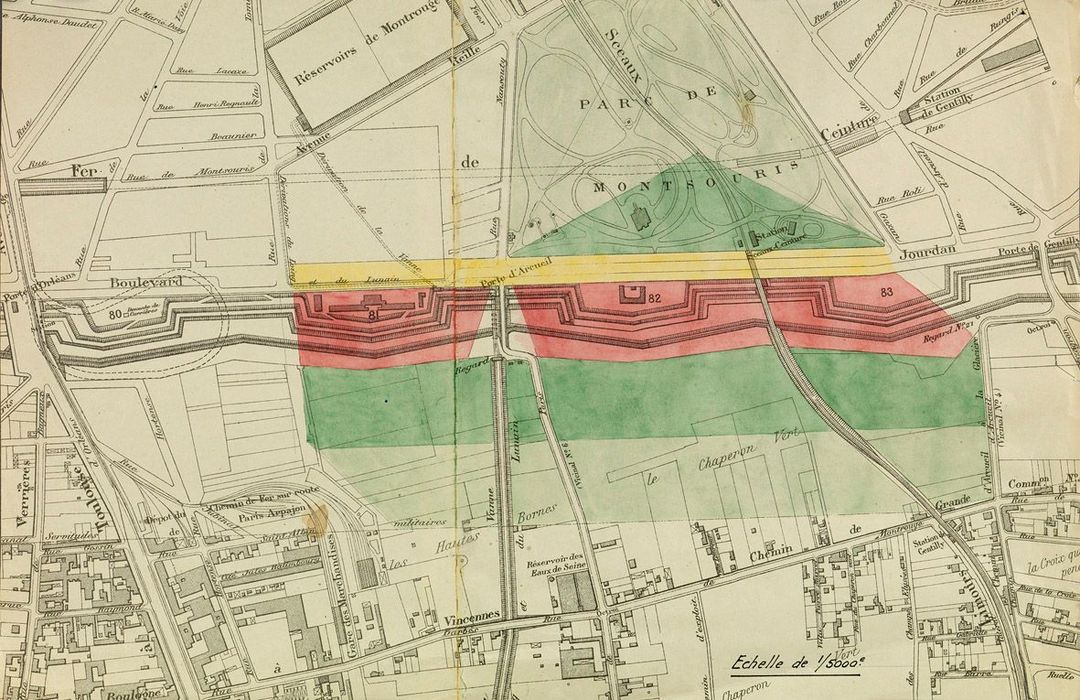
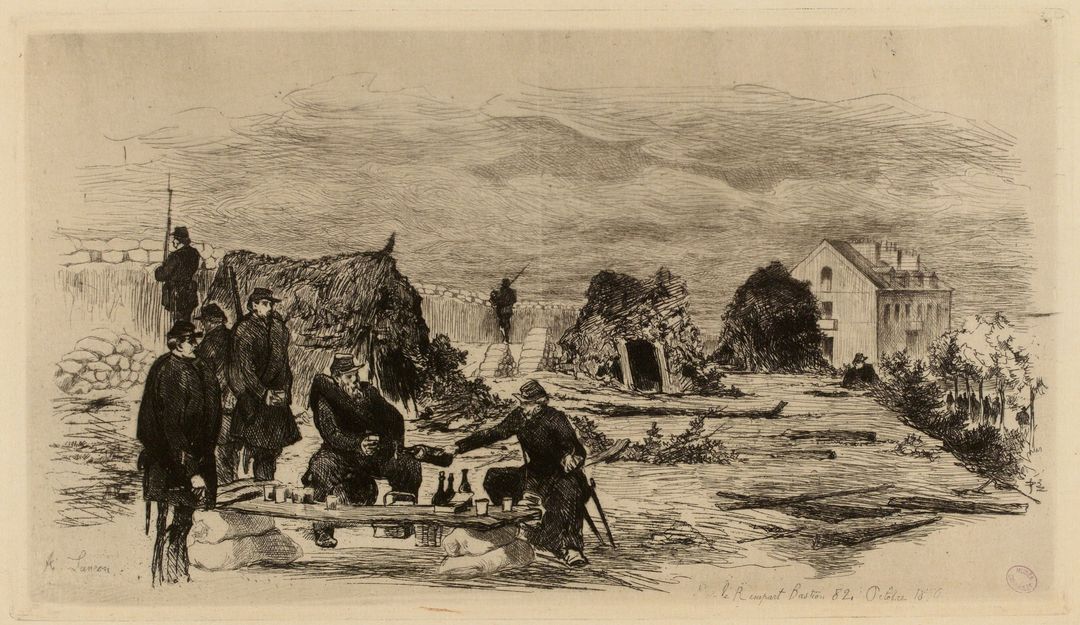
Boulevard Jourdan and all the boulevards of the Maréchaux, follow the old route of the Thiers enclosure (named after Adolphe Thiers, then head of government), the final fortification of the capital, built between 1840 and 1944. This 34 km long wall, then built in the middle of the fields, encompasses the closest villages which will be annexed to Paris in 1860, and sets a new limit for the capital.
 The rampart , 1870 © Paris Musées / Musée Carnavalet - Histoire de Paris
The surrounding wall, 10 meters high, overlooks a large ditch. It has 94 bastions, 62 gates or posterns which allow the collection of the grant, as well as railway crossings and rivers or canals. A 250 m military easement zone, the non aedificandi zone, runs along the exterior side of the enclosure, up to the current ring road.
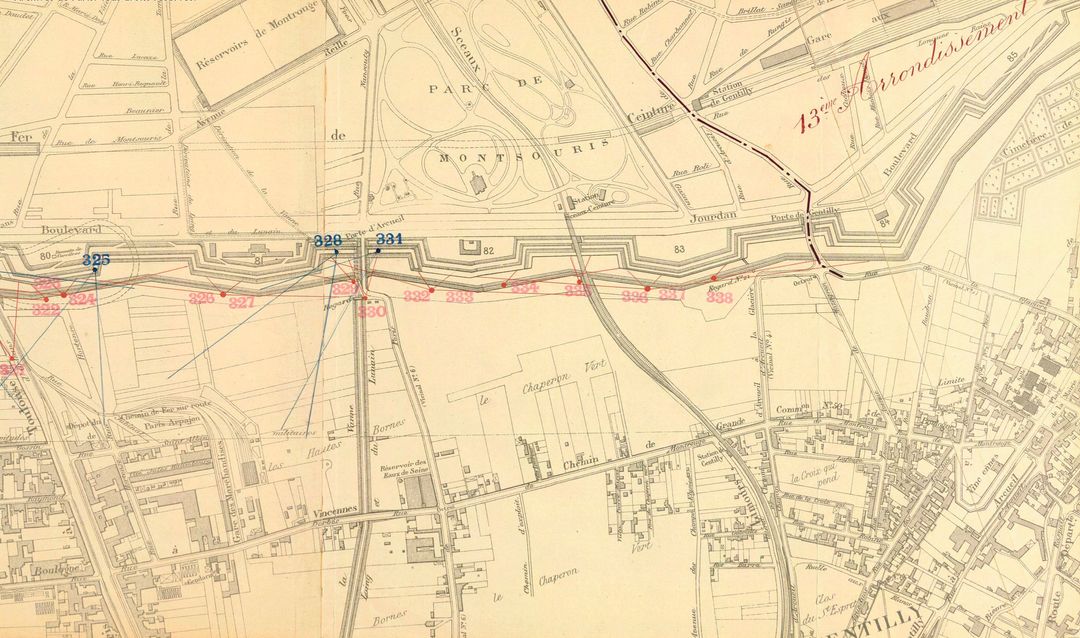
Deemed ineffective during the 1970 war and the siege of Paris by the Prussians, the enclosure was decommissioned in 1919 and gradually demolished until 1929, offering significant land opportunities for the development of urban projects, such as the development of the International University City.
 Porte d’Arcueil © Charles Lansiaux, Department of History of Architecture and Archeology of Paris
There are only few remains of it today, but by going around the Pavilion and taking rue David-Weill, you will be able to see that if the east side of bastion no. 81 was demolished (the street was widened and the stones were used to build the Fondation Deutsch de la Meurthe and the Cité Universitaire Internationale), the west side is still intact.
 © CAUE de Paris
Side activities

Access the journey
 Metro
Metro
Denfert-Rochereau (lines 4 and 6)
 Bus
Bus
Denfert-Rochereau (lines 38, 59, 64, 68 and 88)
 Vélib'
Station n°14005 (René Coty - Place Denfert-Rochereau)
 RER
RER
Denfert-Rochereau (line B)