

Across the Bois de Boulogne
 16ᵗʰ arrondissement
🇬🇧 This journey has been automatically translated from its original french version. The translation might be inaccurate.
What are the challenges faced by a natural space located in a dense and active urban area?
Explore the Bois de Boulogne through this hike which invites you to discover its different environments, its biodiversity, its forest massif, its gardens, and its water circuit.

Want to discover the journey ?
For total immersion, download our app and start the journey now!


Journey preview
A little history
 General plan of the Rouvray forest known as Bois of Boulogne and the castles of Madrid and La Muette with the towns and villages which surround them by Jules Hardouin-Mansart, 1706 © gallica.bnf.fr/Bibliothèque nationale de France
From the forest to the woods
The Bois de Boulogne is located on the territory of what was once part of the Rouvray Forest. Ravaged after the Revolution and the French campaign of 1814, the wood was ceded by the State to the City of Paris in 1852. Napoleon III decided to create a promenade open to all, a mission entrusted to the engineer Adolphe Alphand and the landscaper Jean-Pierre Barillet-Deschamps, two collaborators of Baron Haussmann who directed the transformation work in Paris.
Alphand composes an English landscape with winding paths, ponds, small artificial rivers carrying water and groups of rockeries. The soils and reliefs are remodeled, 200,000 trees are planted. Only two rectilinear paths (those of Longchamp and Reine-Marguerite) are preserved. The architectural elements, chalets, pavilions, kiosks, restaurants, as well as the acclimatization garden, were created by Gabriel Davioud (1823-1881).
 Map of the Bois de Boulogne by Lemière, 1860 © gallica.bnf.fr/Bibliothèque nationale de France
Today's Wood
The Bois de Boulogne is a reservoir of biodiversity of regional importance thanks to its diversity of habitats: wooded areas, undergrowth, herbaceous wastelands, meadows, lakes, rivers, banks of the Seine and ornithological reserve in the middle of a very dense urban fabric. With its 846 hectares, it is 2.5 times larger than Central Park in New York. It also offers city dwellers places for relaxation and conviviality, recreational, cultural, educational activities and places to eat.
With a considerable attendance of more than 6 million visitors per year, the Bois de Boulogne must face the challenge of preserving its natural environments and its ecological balances.
It is also a classified site under the ministerial decree of September 23, 1957, it is also classified as a natural and forest zone in the PLU.
A little history
General plan of the Rouvray forest known as Bois of Boulogne and the castles of Madrid and La Muette with the towns and villages which surround them by Jules Hardouin-Mansart, 1706 © gallica.bnf.fr/Bibliothèque nationale de France
From the forest to the woods
The Bois de Boulogne is located on the territory of what was once part of the Rouvray Forest. Ravaged after the Revolution and the French campaign of 1814, the wood was ceded by the State to the City of Paris in 1852. Napoleon III decided to create a promenade open to all, a mission entrusted to the engineer Adolphe Alphand and the landscaper Jean-Pierre Barillet-Deschamps, two collaborators of Baron Haussmann who directed the transformation work in Paris.
Alphand composes an English landscape with winding paths, ponds, small artificial rivers carrying water and groups of rockeries. The soils and reliefs are remodeled, 200,000 trees are planted. Only two rectilinear paths (those of Longchamp and Reine-Marguerite) are preserved. The architectural elements, chalets, pavilions, kiosks, restaurants, as well as the acclimatization garden, were created by Gabriel Davioud (1823-1881).
Map of the Bois de Boulogne by Lemière, 1860 © gallica.bnf.fr/Bibliothèque nationale de France
Today's Wood
The Bois de Boulogne is a reservoir of biodiversity of regional importance thanks to its diversity of habitats: wooded areas, undergrowth, herbaceous wastelands, meadows, lakes, rivers, banks of the Seine and ornithological reserve in the middle of a very dense urban fabric. With its 846 hectares, it is 2.5 times larger than Central Park in New York. It also offers city dwellers places for relaxation and conviviality, recreational, cultural, educational activities and places to eat.
With a considerable attendance of more than 6 million visitors per year, the Bois de Boulogne must face the challenge of preserving its natural environments and its ecological balances.
It is also a classified site under the ministerial decree of September 23, 1957, it is also classified as a natural and forest zone in the PLU.
Porte d’Auteuil and Auteuil racecourse: the edge of the woods
 Recent aerial view of the edge of the Bois de Boulogne near Auteuil © IGN
On the edge
The edges are very rich ecological environments, which have the essential role of ensuring and maintaining ecological continuities. Those of the Bois de Boulogne are at the interface between urban density and this vast reservoir of biodiversity. They are varied, often heterogeneous and fragmented. These are edges that can be inhabited, infrastructural or porous and which must face numerous challenges:
-
invite you to go to the woods by offering easy access,
-
manage the paths bordering the woods to promote biodiversity (planting, lighting, shelters for small animals, rainwater harvesting, etc.),
-
mitigate the presence of large infrastructures, ring road, motorway, gates, access ramps) which create cuts, noise and pollution.
The edges of the woods are characterized by its doors. The Porte d'Auteuil is marked by the presence of the racecourse, the old Auteuil station and the small belt, in this accessible section, the garden of the Auteuil greenhouses and Roland-Garros, but also access to the ring road and the A13 motorway.
 Oblique aerial view in 1963 on the edge of the woods at Porte d'Auteuil © IGN Remonter le temps
Auteuil racecourse
The Auteuil racecourse was created in 1873 between the fortifications of Paris to the east and the Butte Mortemart, made up of spoil removed during the digging of the lakes to the west. It is the reference racecourse for obstacle races (hurdles and steeplechase).
 Races at Auteuil © Bibliothèque Historique de la Ville de Paris, CPA-4901
It extends over 44 enclosed hectares, thus forming an enclave which restricts access to the Bois de Boulogne from Auteuil. The engineer Adolphe Alphand is the creator of the paths.
 Aerial view in 1919 of the lawns of the Auteuil racecourse © IGN Remonter le temps
In the center of the racecourse, the park of pelouses d'Auteuil is open to public since 2013 thanks to an agreement between France Galop and the City of Paris. Formerly dedicated to the activities of the racecourse, these grounds also offer numerous sports facilities (rugby, football and basketball fields, Auteuil swimming pool).
This 12 hectare park is accessible from the alley of the fortifications outside of horse racing days. Designed by the Péna Paysage agency, its layout aims to recover the landscape value of the site as an integral part of the Bois de Boulogne. The different gardens allow you to cross the racecourse from north to south, thanks to a path from Porte d'Auteuil to Square de Passy.
 The gardens of the lawns of Auteuil © Péna Paysages
This park is a first step towards the opening of the racecourse to the city and the woods and towards a less exclusive use of this immense area. Despite everything, access to wood from Paris is still difficult in this sector and needs to be improved.
Above the périphérique: the edge of the woods
 Thiers enclosure © Charles Lansiaux, DHAAP
The non ædificandi Zone
The Zone was a territory surrounding the fortifications of Paris, a large unobstructed and non-constructible military area reserved for military maneuvers. The Thiers enclosure was a little less than 150 meters wide and consisted of a wall, a ditch, an embankment towards the outside of Paris and a road about ten meters wide. on the interior side. A poor population, to whom we will give the name “Zoniers”, inhabited these lands by building cabins of all kinds. Workers' gardens were also installed there.
 Gardens of the fortifications, Gate of Passy 07-19-1917 © Charles Lansiaux, DHAAP
After the demolition of the fortifications, this huge land reserve gave rise to numerous projects, in particular green belts of parks and walks, which never saw the light of day. This area was eventually built and occupied by public housings, sports facilities and the Paris ring road, called the “Périphérique”.
The Périphérique presence
 Diagram of the Périphérique path under the Bois de Boulogne Le Figaro le 1er juillet 1966
The construction of the Périphérique in 1972 reduced the impact of the Bois de Boulogne by 25 hectares. Under pressure from local residents, but also for technical and financial reasons, the route of the ring road does not take the right of way of the “Zone non aedificandi” but bypasses the Auteuil racecourse to the west and moves away from the residential buildings.
The boulevard is laid out as a trench or tunnel. The tunnel under the upper lake is the longest on the ring road, at 580 meters. These structures strongly mark the promenade and generate noise pollution. 🎧[Find out more about the construction of the ring road in the woods](https://www.ina.fr/ina-eclaire-actu/video/caf94059022/replantation-d-arbres-au-bois-de-boulogne- after-peripheral-works)
The landscape of this edge is more open, light can penetrate through vast clearings, the paths are lined with large grassy benches.
 An alley in the woods © Jean-Pierre Viguie / Ville de Paris
Crossing the woods
 In the forest © Jean-Pierre Viguie / Ville de Paris
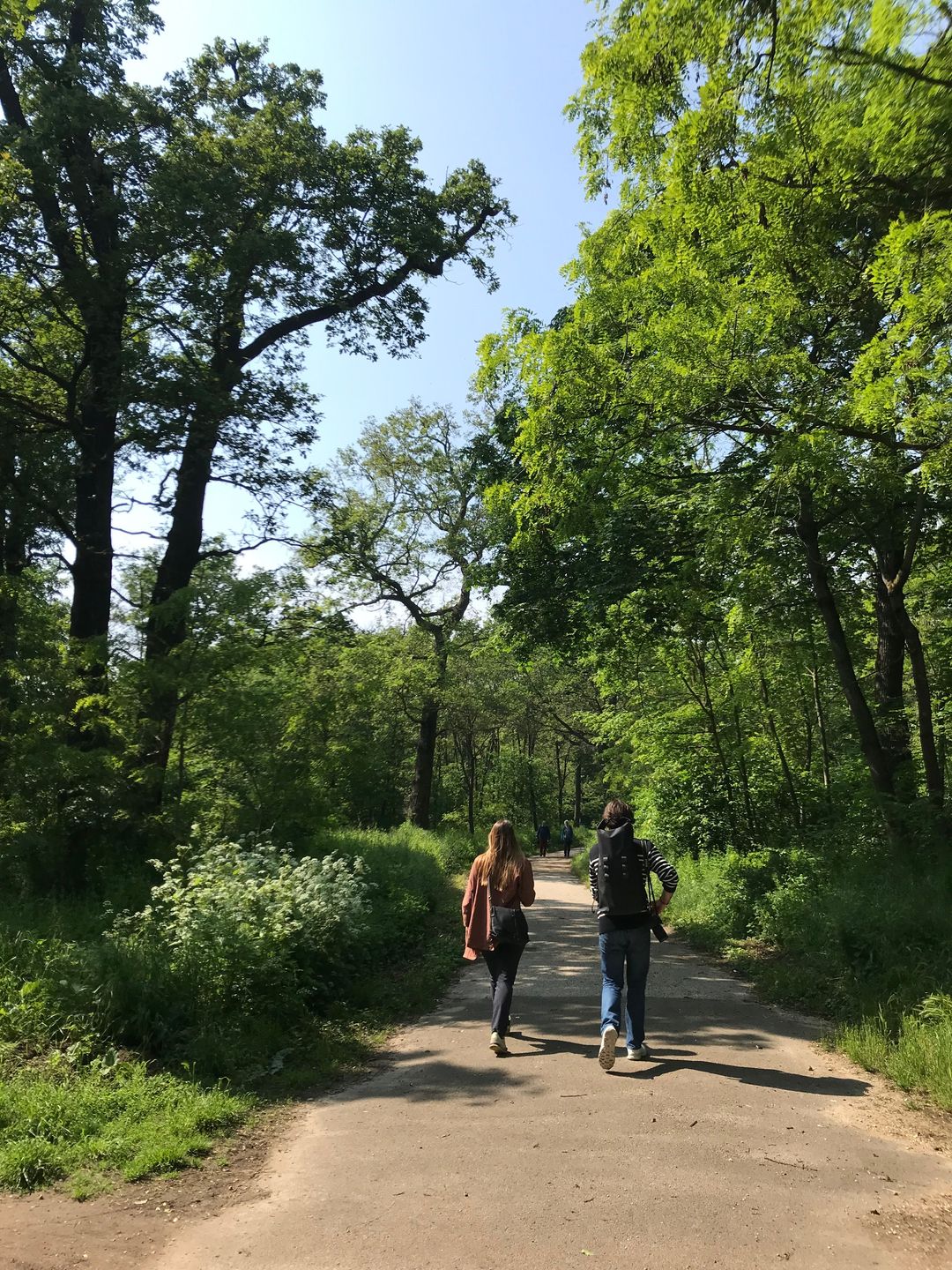
As you cross the woods, you will discover that the forest is characterized by the presence of several layers of vegetation. Here the oaks, sessile oak Quercus petraea and pedunculate oak Quercus robur, dominate and cover more than 50% of the surface of the wood. They are mixed with fast-growing trees such as maples and sycamores, ash and linden. Natural development is encouraged as much as possible, with foresters intervening only when necessary.
 Clearing in the massif © CAUE de Paris
Some areas were very damaged by the storm of 1999, creating large gaps of light which nevertheless allowed the charms to develop.
Preparing for the future of the Bois de Boulogne
Following this event, the first arboreal management plans were developed to restore destroyed forest and horticultural areas. They also make it possible to plan over time the interventions necessary for their management and improvement. The main objectives of these plans are:
-
ensure public safety, through organized and regular monitoring of tree heritage and appropriate interventions, respectful of ecology and the landscape,
-
**sustain and improve the tree heritage **as a whole (forest, garden or alignment) by replanting adapted and diversified species,
-
strengthen biodiversity in the woods, which are coherent ecological groups (with the creation of refuge areas protected from the public, to preserve the fauna and flora),
-
rehabilitate landscape structures and compositions inherited from the history of the woods (put in place by Alphand for the oldest ones).
The interventions carried out between 2006 and 2020 made it possible to reconstruct the tree and forest heritage affected in 1999. The reforestation program focused on diversifying the species planted: in the forest areas, oak is retained as the majority species, but so-called accompanying species such as linden, cherry, hornbeam or birch, are favored. They are essential to the ecological quality and sustainability of afforestation and are preferred to softwoods that are less resistant to wind.
With global warming, beech, sessile oak and pedunculate oak are gradually disappearing and are being replaced little by little by holm oak and downy oak, which are more resistant to drought.
Regeneration plots
 © CAUE de Paris
These plots bathed in light combine plantations and natural regeneration. In spring and autumn, foresters intervene to reduce the most invasive plants (brambles, black locust, ailanthus, hedge clematis, etc.) and preserve the most beautiful and healthiest trees.
Pioneer trees such as silver birches, poplars and locust trees (false acacias) contribute to the reconstitution of the forest appearance, because they grow faster and live less long than the oak. In these plots, the planting or spontaneous development of small, very fruitful trees is favored, such as the rowan, the male dogwood, the hazel or the rosehip, conducive to the presence of birds and mammals. Common wasteland plants settle there and shelter many insects. The flowers of field cirsuses Cirsium arvense attract hoverflies Episyrphus balteatus, a type of yellow and black wasp-looking fly. The umbels of the wild carrot Daucus carota are appreciated by the crab spider Misumena vatia.
It may happen that, for 15 to 20 years, the replanted areas are not accessible to the public and protected by a discreet fence. Respect these sensitive areas and do not cross boundaries.
Aging enclosures
 © CAUE de Paris
These plots are fenced to prevent the public from entering them. They do not undergo any human intervention, apart from securing the limits. They thus constitute true “ecological reserves” and privileged observation sites for the natural evolution of wood. These are often old oak groves of pedunculate oaks Quercus robur and sessile oaks Quercus petraea made up of trees that can live for a few more decades but also trees that die quickly following episodes of heatwave.
During your crossing of the forest, you can listen to this short audio capsule: 🎧 The wood cricket Nemobius sylvestris which lives hidden under the leaves.
The Great Waterfall: water in the woods
 La Grande Cascade © Christophe Noel / Ville de Paris
Water is the common thread of many walks in the woods. It is at the heart of picturesque and bucolic settings, views of the landscape. Peaceful and calm when it is located at a high point, it flows spectacularly thanks to the topography and slope breaks.
The Great Waterfall is one of the highlights of the Bois de Boulogne. It was built in 1956. More than 2,000 m³ of concrete and 4,000 m³ of Fontainebleau sandstone rocks made it possible to create two superimposed caves accessible to the public. The waterfall is an important element of the hydrographic network of the woods, it is fed upstream by the reservoir pond. This body of water fills at night and allows the flow to be varied to accentuate the spectacular effect of this 7.50 meter fall.
You can admire two remarkable trees to the right of the waterfall: a cedar Cedrus atlantica 25 meters high and a bald cypress Taxodium distichum 28 meters high.
 The Great Waterfall cave frozen in ice in 1917, Agence Rol © gallica.bnf.fr / Bibliothèque nationale de France
Near the waterfall, Napoleon III had a pavilion built for his stops in the woods. Having become a restaurant for the Universal Exhibition of 1900, it was enlarged and adopted a Belle Epoque decor. Damaged during the Second World War, the pavilion underwent various transformations until the current restaurant and its “retro-modern” style.
The Great Waterfall is unfortunately not very visible due to the numerous parking lots which occupy its surroundings.
The Grande Cascade offers a clear view of the Suresnes hillsides.
Bird reserve
 Peony bullfinch © V.FERRIOT-LPO IDF
This 3 hectare plot is fenced to protect it from walkers and dogs. It thus ensures the tranquility of nesting birds and migratory birds in winter.
By remaining discreet, you may be able to observe peony bullfinch, gray warblers, polyglot hypolais, thrushes draine, green woodpeckers and chiffchaffs…
 Chiffchaff fitis © JB.ALEMANNI-LPO IDF
Birds come to feed on the berries of small trees such as the monogyne hawthorn Crataegus monogyna, black elderberry Sambucus nigra, blackthorn Prunus spinosa and wild service Sorbus domestica planted for this purpose from the creation of the reserve in 1991.
 Polyglot hypolais © L.LANNOU-LPO IDF
The reserve also offers them numerous habitats:
- hedges and dense bushes of burnet roses Rosa pimpinellifolia and barberries Berberis julianae to shelter the garden warbler Sylvia borin.
- deading trees suitable for nesting of cavity-dwelling species such as the spotted woodpecker Dendrocopos minor. They are also attractive to microfauna which the garden creeper Certhia brachydactyla feeds on. This bird tirelessly explores the crevices of the bark with its thin, arched beak, in order to extract insects, larvae, spiders, woodlice or centipedes.
🎧 Find out more about the garden creeper on Briefs of Wild Nature.
 Climber gardens © L.LANNOU-LPO IDF
Pheasants have also taken over this refuge to nest there. Pairs of warblers have become more numerous and nightingales, birds that have become rare, have even been spotted.
 European kingfisher © F. GONOD-LPO IDF
The Lonchamp stream crosses the three hectares of the reserve and sometimes offers the opportunity to surprise the kingfisher Alcedo atthis which is not easy to observe despite its bright colors, as it is so fast in flight. 🎧 Find out more about the kingfisher on Briefs of Wild Nature.
Longchamp creek: water in the woods
 Longchamp creek © CAUE de Paris
The importance of water
The Bois de Boulogne is home to 14 artificial lakes and ponds connected by 10 kilometers of streams which guide the walk: the Longchamp stream, the Sablons stream and the Armenonville stream. The water network is supplied via the Passy reservoir by the Auteuil plant which pumps its water into the Seine and flows following the natural slopes. This non-potable water network also makes it possible to water lawns and maintain roads. It is possible to fish in certain places.
This "blue frame" makes it possible to create wetlands rich in biodiversity.
Welcoming and promoting biodiversity
Improvements were made following the damage caused by the 1999 storm, in particular waterproofing repairs as well as the planting and renaturation of the banks. Some sections had to be concreted because the dogs damaged the clay waterproofing and degraded the banks. Gabions (metal cage filled with stones) and coconut canvas mats were installed to restore more natural banks. The level of the Longchamp stream was also raised by 15 centimeters to occasionally flood certain parts of the woods.
These devices promote the development of wetlands and allow fish and amphibians to develop.
 The Longchamp creek in the Pré-Catelan garden © Sonia Yassa / Ville de Paris
In order to ensure the sustainability and diversity of species frequenting this environment, the rivers are cleaned every 4 to 5 years. The river bottom is dried and some of the mud is removed. This silt is analyzed to ensure its quality before being spread to enrich meadow areas. Cleaning is carried out at the end of autumn, at a time when there is less disturbance to wildlife. The spring reproduction of amphibians such as the common frog Rana temporaria and the spotted newt Triturus vulgaris is thus preserved.
Pré Catelan and Shakespeare Garden
 Bucolic landscape of the Pré-Catelan garden © Sonia Yassa / Ville de Paris
A Haussmannian garden
Le Pré Catelan is one of the most romantic places in the Bois de Boulogne, it is one of the parks and gardens created as part of the transformation of Paris by Baron Haussmann.
On the site of the garden, there was a stone extraction quarry used for paving the paths of the woods. This quarry was closed and transformed in 1858 into an amusement park for adults who came to ride rides, ride a velocipede, listen to concerts, attend magic tricks and drink fresh milk at the dairy. This 8-hectare festive venue had a landscaped garden designed by Gabriel Davioud and Jean-Pierre Barillet-Deschamps. Of the amusement park destroyed by the war of 1870, what remains is the dairy, the Pré Catelan restaurant and the green theater.
 Pré Catelan meadow © Sonia Yassa / Ville de Paris
Several magnificent and remarkable trees are to be discovered such as the large-flowered magnolia Magnolia grandiflora whose flowering is spectacular all summer long, the sequoia Sequoiadendron giganteum of 32 meters planted in 1872 and a persimmon tree Diospyros kaki 15 meters high. Beware of the thorns of the Chilean araucaria Araucaria araucana, a tree native to the Peruvian and Chilean Andes, also called "the despair of the monkeys" its very pointed leaves making its ascent impossible for primates. Nearby, a huge plane tree Platanus x hispanica 45 meters high sits along the Longchamp stream.
The whole world is a theater,
And all men and women are just comedians. William Shakespeare, As You Please, Act II Scene VII line 139
The Shakespeare Garden is located in the Pré Catelan garden. It has the particularity of being built around a green theater whose stage is surrounded by trees, in particular a hundred-year-old oak and lush vegetation. The spectators are seated on a lawn and the caves hide corridors, dressing rooms and a room where the sets are stored.
 The theater of flowers of Pré Catelan in 1865, engraving by Jules Gaildrau - Public domain
This theater was created in 1857 under the name “theater of flowers”. In the 1950s, Marie-Louise Hemphill Loir, daughter of the bacteriologist Adrien Loir and wife of an English doctor, rehabilitated the hemicycle which had fallen into disuse with her own funds. Almost a century after its birth, the theater is resurrected under the name of “Shakespeare Garden” animated in the summer by a live performance festival which held from May to September.
Vegetation evokes five of the plays of Britain's greatest playwright:
- cypresses, aromatic plants and palm trees allude to the Mediterranean island of “La Tempête”,
- dark and dense vegetation composed of yews recalls the Forest of Arden from the comedy “As You Like It”,
- the ferns, heathers and birches transport us to the Scottish heath of the witches of “Macbeth”,
- the willow and the stream recall the tormented landscape of “Hamlet”,
- the waterfall and the oaks are a nod to Greece from “A Midsummer Night’s Dream”.
“...and then I thought I saw the forest begin to move.” William Shakespeare, Macbeth act V, scenes 4 and 5
The Lower Lake: water in the woods
 The Upper Lake © Vincent Guiné - CAUE de Paris
The blue infrastructure
The blue network, network of aquatic continuities, is notably made up of different bodies of water located in the four corners of the Bois de Boulogne:
- the Upper and Lower Lakes (Lacs supérieurs et inférieur),
- Saint-James Lake, near Neuilly-sur-Seine,
- the reservoir lake near the Great Waterfall,
- the ponds of Longchamp, Tribunes, Suresnes and Boulogne near the Longchamp racecourse and the river Seine.
The Upper and Lower Lakes are the high points of the hydrographic network of the Bois de Boulogne. They feed streams and other bodies of water thanks to the topography of the land. They are supplied by a non-potable water network, managed by fountain managers who ensure the closing and opening of valves to renew the water in the lakes, maintain the flow in the rivers and waterfalls, guarantee a water level sufficient. The Upper Lake and the Lower Lake are connected by a small waterfall 10 meters wide. The water from this circuit flows into the sewer through various outlets.
The Lower Lake is the largest lake in the Bois de Boulogne, it has two islands connected by a suspension bridge. The largest houses a chalet restaurant accessible only by boat. The lake is sealed with a concrete base covered with a mortar coating, it is hidden by the thickness of the earth on its banks.
Daydreaming, romance and holiday atmosphere
 View of the Bridge of the Islands in 1967, engraving by Henri Corbel - Public domain
The Bois de Boulognes lakes have always been places for walks and leisure activities, very popular with Parisians eager for space, romantic landscapes and freshness. The upper lake has always offered many uses: canoeing with boat rental, picnics on the banks, tavern, romantic walks. Skating in winter is becoming increasingly rare, due to the lack of extreme cold!
 Wood Skating, February 1919 © gallica.bnf.fr/Bibliothèque nationale de France
 Skaters in the Bois de Boulogne, Pierre Brunet and Miss Jolly, February 1919 © gallica.bnf.fr/Bibliothèque nationale de France
Evolution of lake uses
Outdoor swimming projects such as exist in several large European cities, the famous "swimming ponds" in Hampstead Heath park in London or in Zurich, Switzerland, have been regularly mentioned as possible new uses.
 Canoeing © CAUE de Paris
In recent years, the lakes of the woods have been adapted to promote biodiversity in the wet and aquatic environments of the woods. The new developments, such as the renaturation of stream banks and appropriate management, have borne fruit. Plants and animals characteristic of wetlands, such as the yellow water lily Nuphar lutea, the depressed dragonfly Libellula depressa, the common frog Rana temporaria and the spotted newt Triturus vulgaris, are well represented.
The blue network of the Bois de Boulogne can be further developed by the creation of new rivers, new bodies of water or new wetlands and lagoons in order to find a balance between protection and enhancement of biodiversity and leisure uses.
Route de Suresnes: the edge of the woods
Finding a forest atmosphere
 Route de Suresnes Charles Marville 1858-1862 © Paris Musées/Musée Carnavalet – Histoire de Paris
As part of the development of the Bois de Boulogne and important heritage sites, part of this road, linking Étoile to the Suresnes bridge, has been cut off from car traffic and dewatered. This transformation makes it possible to regain the continuity of Alphahand’s developments and to highlight its heritage. The road is now reserved for pedestrian or bicycle traffic.
 © CAUE de Paris
Recovering rainwater
These developments also make it possible to better use of rainwater by infiltrating it into the ground and reducing waterproofing wherever appropriate. Here, the classic "sidewalk-roadway-sidewalk" road profile has been removed to create a forest alley atmosphere by reducing the width of the waterproof surface and removing curbs and gutters. A meadow and plantations were created in place of the central road.
Rainwater no longer flows into sanitation systems but penetrates directly into the ground through planted and grassed areas. This allows the plantations to be watered, the soil and the city to be refreshed by recharging the water tables.
Porte Dauphine and avenue Foch
 Zoom in on an oblique aerial photo of Avenue Foch in 1956 © IGN Remonter le temps
A summary of the Haussmannian system
Avenue Foch, formerly Avenue de l'Impératrice then Avenue du Bois de Boulogne, connects Place de l'Étoile to Place Dauphine and the Bois de Boulogne.
It is the most ambitious avenue of the Haussmannian promenade system, it measures 1,200 meters long and 140 meters wide. It was developed in 1855 at the same time as the Bois de Boulogne, the Pré Catelan garden and the Shakespeare garden.
We find there the 3 scales of the walking system that Haussmann and Alphand developed in Paris:
- the scale of the metropolis: the creation of the avenue anticipates urban development and service to the territory,
- the scale of the district: the avenue is part of its context and provides views and perspectives,
- the small scale: the design of the avenue, which offers small local gardens and suitable furniture, meets a requirement for quality aesthetics and uses.
 Profile and detail of furniture on Avenue de l'Impératrice (Avenue Foch)
 The bridleways of Avenue Foch around 1890 © Ville de Paris / Bibliothèque historique , 4-ALB-0008-007
A unique avenue in Paris
The 16 meter wide central roadway is framed by two lateral bridle paths of 12 meters bordered by large grassy and tree-lined gardens designed by Alphand, then by two side paths of 9 meters which run alongside the properties and their 10 meter wide pleasure gardens.
The unpaved bridle paths, the benches and the furniture similar to that of the squares, as well as the uniform design of the grids along the private gardens which border the valleys reinforce the landscaped character of this unique space in Paris.
 The perspective of avenue Foch © Valentina Lazzarone
With more than 4,000 trees, the avenue is a veritable arboretum of 2,400 plant species. Many remarkable trees can be discovered in the gardens, including a Siberian elm Zelkova carpinifolia classified as remarkable for its size and its footprint in the landscape at the level of the lawn opposite numbers 62-64 of the avenue , several majestic plane trees, a Byzantian hazel tree Corylus colurna, a magnificent holm oak Quercus Ilex which you can admire at the lawn in front of number 22 of the avenue, in the continuity of rue Chalgrain as well as a soap maker Koelreuteria paniculata just next to the holm oak.
Side activities

Access the journey
 Bus
Bus
Michel-Ange-Auteuil (lines 52 and 62)
 Metro
Metro
Michel-Ange-Auteuil (lines 9 and 10)
 Vélib'
Station 16034 (Porte d’Auteuil)